Atrophic vaginitis
Exam relevance: in 2 of 197 board exam reports · rank 144
- Specialty
- Gynaecology · Vulva & vagina
- Images
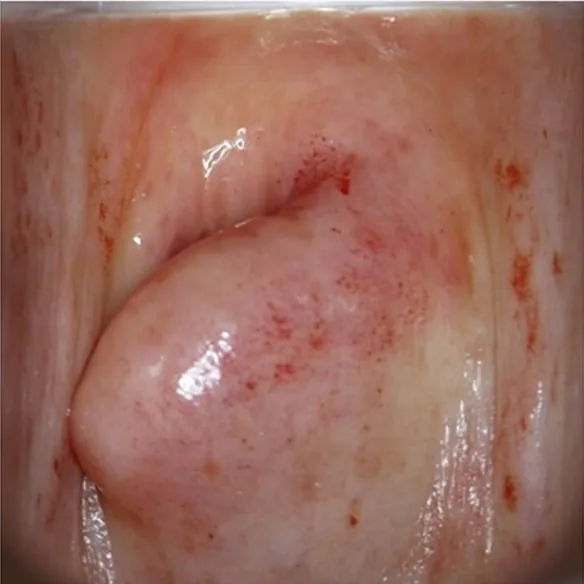
- Colposcopy 1
- Exam relevance
- 2 of 197 reports · rank 144
- In the app
- 2 flashcards · GynFuchs
- Last updated
- 10/2026 · Dr. Pascal Bafteh
Contents
Images (1)
Definition
- Atrophic vaginitis is part of the genitourinary syndrome of menopause (GSM), which comprises the genital, sexual and urinary changes resulting from oestrogen deficiency.
- The vagina, labia, urethra and bladder are affected.
Occurrence & epidemiology
Epidemiology
- Reported prevalence among postmenopausal women ranges from 14 to 87 %; a recent review gives about 40 % of postmenopausal women for vulvovaginal atrophy.
- Unlike vasomotor symptoms, the genitourinary changes progress with ageing.
Aetiopathogenesis
Aetiology and risk factors
- The cause is oestrogen deficiency, mainly after the menopause, but also during lactation, with hypothalamic amenorrhoea and with primary ovarian insufficiency.
- As oestrogen falls, glycogen and lactobacilli decline, the pH rises above 5, and the epithelium becomes thinner, less elastic and less vascular.
Clinical features
Findings (Case File 141)
- What is seen on speculum examination: pale, smooth, vulnerable mucosa.
- Typical accompanying symptoms: dryness, burning, itching, dyspareunia.
- A wet mount shows: parabasal cells, elevated pH.
- Why the atrophy develops: oestrogen deficiency: thinner epithelium, glycogen loss.
- Additional consequences: urinary tract infections and urgency.
Accompanying menopausal symptoms
- Cardinal symptom: hot flushes and sweating, i.e. vasomotor symptoms.
- Other common complaints: sleep disorders, mood swings, loss of libido.
- The genitourinary syndrome: vaginal dryness, dyspareunia, recurrent UTIs.
- What affects almost everyone, but is noticed late: accelerated bone loss.
- Typical symptoms are vaginal dryness, burning and irritation, pain during intercourse, and urinary urgency, frequency and dysuria.
- Recurrent urinary tract infections and bleeding during intercourse may also occur.
Diagnosis
Typical imaging findings
- Colposcopy: The cervix is strikingly pale, the epithelium looks thin and translucent, and the os is narrow and hard to probe. Pinpoint and streak-like haemorrhages are scattered over the surface and the adjacent vaginal wall; there is no circumscribed tumour.
- The mucosa appears pale, thin and dry, with reduced rugae, petechiae and increased friability.
- Vaginal pH is typically above 5, although this also occurs in bacterial vaginosis; the maturation index shows a predominance of immature parabasal cells.
Keep learning in the app
Further reading (selection)
Cross-references
Note: Learning content from the GynFuchs app (flashcards, exam questions, image cases) for medical education – not a treatment recommendation and no substitute for diagnosis or treatment decisions in individual cases. Treatment and management are deliberately not covered on this page.