Wolff-Parkinson-White syndrome
Board exam relevance: in 2 of 105 exam reports · rank 142- Synonyms
- WPW, pre-excitation syndrome, accessory pathway, bundle of Kent, delta wave, AVRT, racing heart
- Specialty
- Internal medicine · Cardiology
- Images
- ECG 1
- Last updated
- 10/2026 · Dr. Pascal Bafteh
Contents
Images (1)
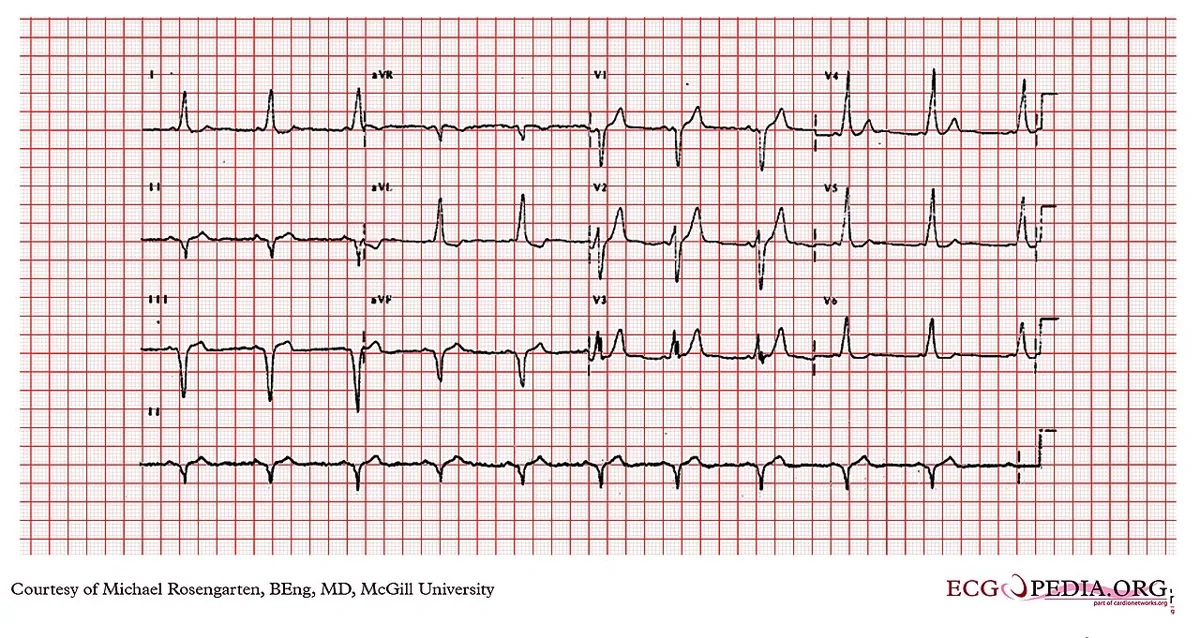 ECG
ECGDefinition
In Wolff-Parkinson-White (WPW) syndrome, an accessory pathway connects atrium and ventricle, circumventing the AV node. When the pathway conducts antegradely, part of the ventricular myocardium is activated early (pre-excitation): short PR interval (below 120 ms), slurred QRS upstroke (delta wave) and widened QRS complex. Pre-excitation together with paroxysmal tachycardias defines manifest WPW syndrome.
Classification
- Manifest WPW syndrome: antegrade conduction over the pathway, pre-excitation on the resting ECG
- Concealed pathway: conducts only retrogradely; the resting ECG is normal, orthodromic tachycardia is still possible, but there is no risk of rapid conduction of atrial fibrillation
- About 5 % of people with an accessory pathway have multiple pathways.
- Permanent junctional reciprocating tachycardia (PJRT): rare, near-incessant form via a usually posteroseptal pathway that conducts only retrogradely and very slowly; may cause tachycardia-induced cardiomyopathy
Occurrence & epidemiology
Atrioventricular reentrant tachycardia (AVRT) is the most common tachycardia in WPW syndrome and accounts for about 20–30 % of all paroxysmal supraventricular tachycardias in adults. In children, AVRT is relatively more common than AV nodal reentrant tachycardia.
Clinical features
Tachycardia mechanisms
- Orthodromic AV reentrant tachycardia (AVRT), about 95 % of AVRT: antegrade conduction via the AV node, retrograde via the accessory pathway; narrow QRS complexes
- Antidromic AVRT (less common): reentry in the opposite direction, antegrade via the accessory pathway; wide QRS complexes
Typical are sudden-onset, sudden-offset, rapid, regular palpitations, often with dyspnea, chest discomfort or light-headedness. Attacks last seconds to hours. Most affected people become symptomatic in young adulthood or middle age.
If atrial fibrillation occurs with manifest pre-excitation, the rate-limiting effect of the AV node is lost; ventricular rates of sometimes 200–300/min can degenerate into ventricular fibrillation and sudden death. This is an emergency.
Diagnosis
- Resting ECG: short PR interval, delta wave and widened QRS complex with a manifest pathway; normal with a concealed pathway
- ECG during tachycardia (orthodromic AVRT): rapid, regular narrow-complex tachycardia; the retrograde P wave always follows the QRS complex and lies in the first half of the RR interval (RP shorter than PR), negative in II, III and aVF
- Antidromic AVRT: wide QRS complexes, because the ventricles are activated exclusively via the accessory pathway
- Atrial fibrillation with WPW: irregular, very rapid wide-complex tachycardia with varying QRS width
- Previous ECGs are reviewed for signs of pre-excitation; ambulatory ECG and electrophysiological study clarify the location and properties of the pathway.
Keep learning in the app
Further reading (open access)
- MSD Manual Professional: Reentrant (Paroxysmal) Supraventricular Tachycardias (PSVT)
- MSD Manual Professional: Atrial Fibrillation and Wolff-Parkinson-White Syndrome
- StatPearls: Wolff-Parkinson-White Syndrome
- Pre-Excited Atrial Fibrillation in Wolff-Parkinson-White (WPW) Syndrome (Rev Cardiovasc Med 2024, PMC11263991)
Cross-references
More topics: Cardiology
- Acute coronary syndrome (heart attack, STEMI/NSTEMI)
- Heart failure
- Atrial fibrillation
- Arterial hypertension (high blood pressure)
- Atrioventricular block
- Secondary hypertension
- Hypercholesterolemia and familial hypercholesterolemia
- Infective endocarditis
- Long QT syndrome and torsades de pointes
- Myocarditis
- Bundle branch block (left and right)
- Ventricular tachycardia
Note: Learning content for medical education – not a treatment recommendation and no substitute for diagnosis or treatment decisions in individual cases. Treatment and management are deliberately not covered on this page.