Triple-negative breast cancer
Exam relevance: in 25 of 197 board exam reports · rank 30
- Specialty
- Gynaecology · Breast
- Images
- Ultrasound 2
- Exam relevance
- 25 of 197 reports · rank 30
- In the app
- 1 flashcards · GynFuchs
- Last updated
- 10/2026 · Dr. Pascal Bafteh
Contents
Images (2)
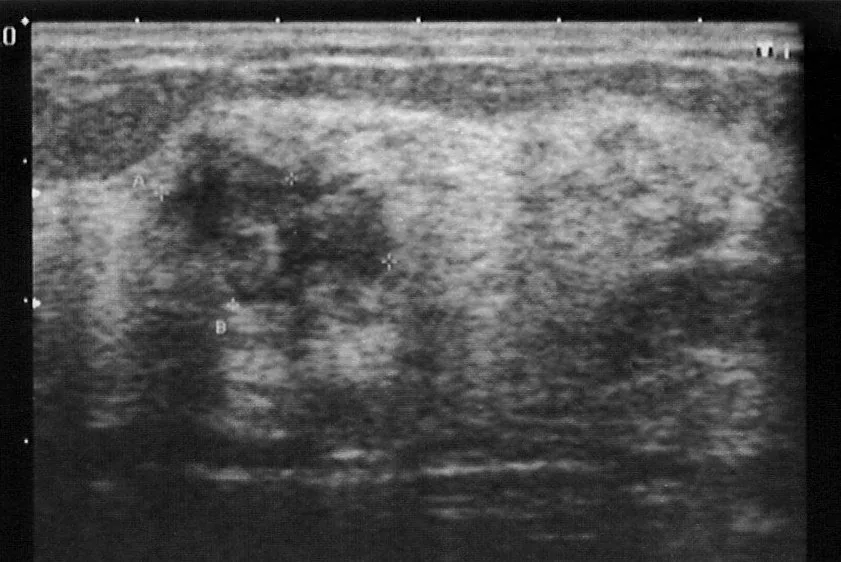 Ultrasound
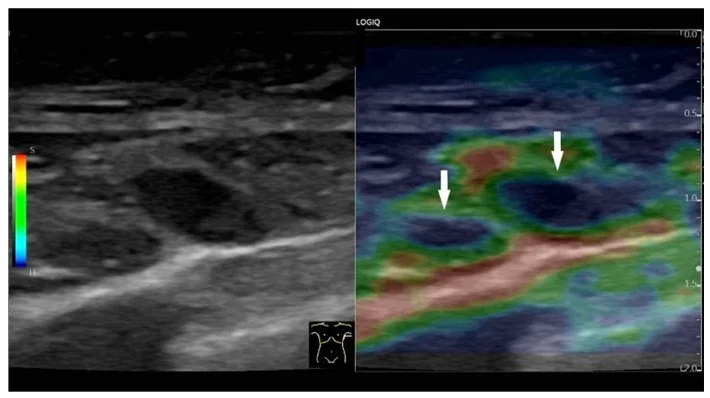 Ultrasound
Definition
Why it is unfavourable
- Definition: Triple-negative means: oestrogen receptor, progesterone receptor and HER2 are negative.
- Typical features: Characteristic features are young age at diagnosis, high grade, high Ki-67 and early visceral metastases.
- Breast cancer lacking oestrogen and progesterone receptors and making little or no HER2, i.e. negative for all three biomarkers.
Classification
- BRCA1-associated breast cancers fall mostly within the triple-negative group and overlap with the basal-like subtype.
Occurrence & epidemiology
Epidemiology
- About 15% of all breast cancers are triple-negative.
- Triple-negative breast cancer is often diagnosed at a younger age and is more common, and diagnosed earlier, in Black women.
- Women with changes in BRCA1 or BRCA2 are more frequently affected.
Aetiopathogenesis
Aetiology and pathogenesis
- The cause is unknown, and the other risk factors are the same as for other breast cancers.
- In a large series of BRCA2 carriers, 16% had triple-negative tumours.
Clinical features
- Triple-negative breast cancer is usually diagnosed at a later stage, grows more quickly and is more likely to recur than other invasive breast cancers.
- Because of its rapid growth it is rarely diagnosed as DCIS (stage 0) and is almost always invasive.
- Symptoms are the same as for most other breast cancers, but symptoms may also be absent.
Histology
- BRCA1-associated, mostly triple-negative carcinomas more often show medullary histology and a higher histological grade.
Diagnosis
- After imaging with mammography, ultrasound or MRI and biopsy, biomarker tests on tumour tissue reveal the triple-negative status.
- PET or CT serve to assess spread; staging combines the extent of spread, triple-negative status and tumour grade.
- Among women with triple-negative breast cancer, germline BRCA1 variants are found more often, particularly when diagnosed before the age of 50.
Keep learning in the app
Further reading (selection)
Cross-references
More topics: Breast
Note: Learning content from the GynFuchs app (flashcards, exam questions, image cases) for medical education – not a treatment recommendation and no substitute for diagnosis or treatment decisions in individual cases. Treatment and management are deliberately not covered on this page.