Hereditary breast and ovarian cancer syndrome (BRCA)
Exam relevance: in 17 of 197 board exam reports · rank 39
- Specialty
- Gynaecology · Breast
- Images
- Histology & cytology 2
- Exam relevance
- 17 of 197 reports · rank 39
- In the app
- 2 flashcards · GynFuchs
- Last updated
- 10/2026 · Dr. Pascal Bafteh
Contents
Images (2)
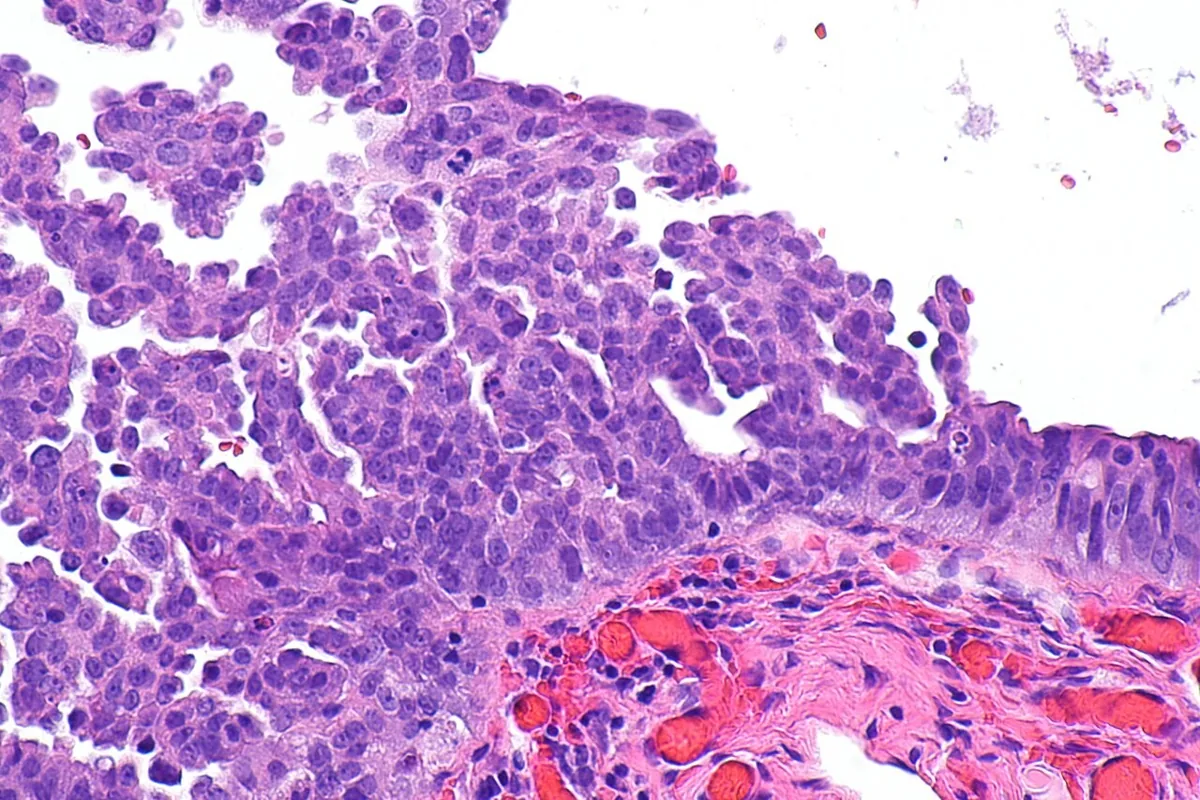 Histology & cytology
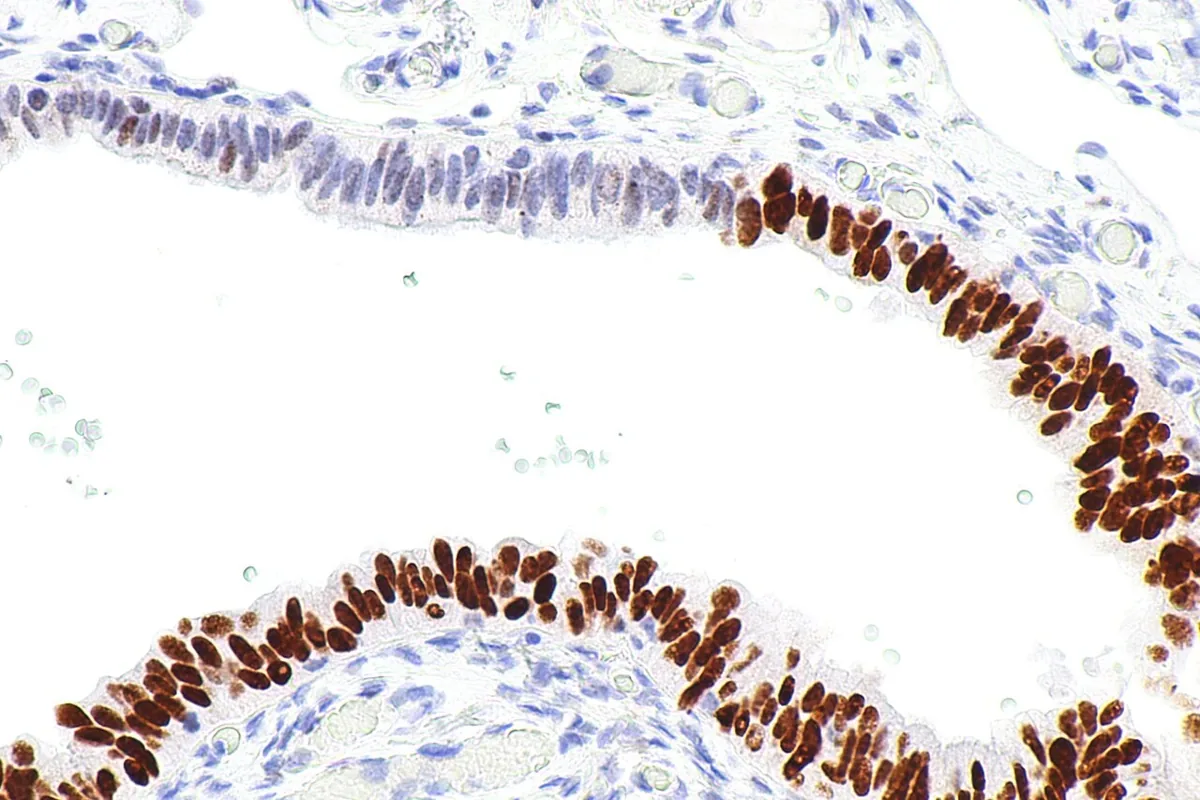 Histology & cytology
Definition
- Hereditary cancer predisposition syndrome caused by pathogenic germline variants in BRCA1 (long arm of chromosome 17) or BRCA2 (long arm of chromosome 13), with an increased risk mainly of breast and ovarian cancer.
- Inheritance is autosomal dominant.
Occurrence & epidemiology
Epidemiology
- Pathogenic variants in highly penetrant genes such as BRCA1 and BRCA2 are rare in the general population and are estimated to account for no more than 5–10% of all breast and ovarian cancers.
- About 1 in 400 to 1 in 800 people in the general population without Ashkenazi Jewish ancestry carry a pathogenic BRCA1 or BRCA2 variant.
- BRCA1: According to two meta-analyses, the cumulative risk by age 70 is 55–65% for breast cancer and 39% for ovarian cancer.
- BRCA2: According to two meta-analyses, the cumulative risk by age 70 is 45–47% for breast cancer and 11–17% for ovarian cancer.
- About 2% of people of Ashkenazi Jewish descent carry a pathogenic BRCA variant, usually one of three founder variants.
Aetiopathogenesis
BRCA and HRD
- BRCA1/2 function: BRCA1 and BRCA2 are tumour suppressor genes involved in homologous recombination, which repair DNA double-strand breaks.
- HRD definition: HRD means homologous recombination deficiency, i.e., the functional defect of this repair pathway even without a BRCA mutation.
- Germline vs. somatic mutation: A germline mutation differs from a somatic mutation in that it is present in all body cells and can be inherited.
Who is tested
- Test material: Testing is performed on the germline from blood and additionally the tumour for somatic mutations and homologous recombination deficiency.
- Prevalence: About one in five ovarian cancers carries a germline mutation in BRCA1 or BRCA2.
Aetiology and pathogenesis
- BRCA1 and BRCA2 behave like tumour suppressor genes, and the normal allele is often lost in the tumours; their proteins take part, among other things, in the repair of DNA double-strand breaks by homologous recombination.
- Other genes associated with an increased risk of breast or ovarian cancer include PALB2, CHEK2, ATM, RAD51C, RAD51D, TP53 and PTEN.
Clinical features
More facts from the study questions
- Analysis for a heritable mutation (germline mutation) is performed on a blood sample.
- The BRCA1 and BRCA2 genes are crucial for the repair of DNA double-strand breaks.
- This repair mechanism is known as homologous recombination.
- The start of intensified early detection is determined by the index case in the family.
- It therefore usually begins well before the age of the general mammography screening programme.
- Lynch syndrome is based on a defect in DNA mismatch repair, not homologous recombination.
- An indicator of this is the loss of mismatch repair proteins in immunohistochemistry.
- The mean age of onset for BRCA1 mutation carriers is younger than for BRCA2.
- Clues in the personal or family history are breast cancer at or before age 50, ovarian cancer, male breast cancer, pancreatic cancer, metastatic or high-risk prostate cancer, a known BRCA variant in the family and Ashkenazi Jewish ancestry. Multiple primary cancers in one person, such as bilateral breast cancer, also point to a hereditary cause.
- Breast cancers in BRCA1 carriers are mostly triple-negative or basal-like and more often high grade, whereas those in BRCA2 carriers are mainly oestrogen and progesterone receptor-positive.
- BRCA2 additionally predisposes to prostate and pancreatic cancer and to male breast cancer; an association with melanoma has not been shown in all studies.
Histology
- BRCA1-associated breast cancers show medullary histology more often than expected and overlap considerably with the basal-like subtype.
- BRCA-associated ovarian cancers are more often high-grade serous adenocarcinomas and less often mucinous or borderline tumours; occult lesions in the fallopian tubes suggest that many of them originate in the tube.
Diagnosis
- The diagnosis is made by molecular genetic germline analysis of blood or saliva, either as a two-gene analysis of BRCA1 and BRCA2 or as a multigene panel.
- Results are reported as pathogenic or likely pathogenic, negative, or a variant of uncertain significance; a variant of uncertain significance does not establish an increased cancer risk and, as more data accumulate, is mostly reclassified as benign.
Keep learning in the app
Further reading (selection)
Cross-references
Note: Learning content from the GynFuchs app (flashcards, exam questions, image cases) for medical education – not a treatment recommendation and no substitute for diagnosis or treatment decisions in individual cases. Treatment and management are deliberately not covered on this page.