TAPS and TRAP sequence
Exam relevance: in 2 of 197 board exam reports · rank 144
- Specialty
- Obstetrics · Pregnancy disorders
- Images
- Ultrasound 1
- Exam relevance
- 2 of 197 reports · rank 144
- In the app
- 1 flashcards · GynFuchs
- Last updated
- 10/2026 · Dr. Pascal Bafteh
Contents
Images (1)
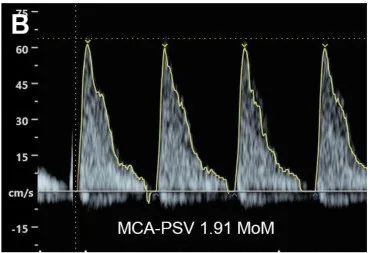 Ultrasound
Definition
- TAPS (twin anaemia–polycythaemia sequence) is a complication of monochorionic twins caused by minute (less than 1 mm) arteriovenous anastomoses through which blood flows slowly from donor to recipient; the result is highly discordant haemoglobin levels without amniotic fluid discordance.
- TRAP sequence (twin reversed arterial perfusion) is a complication of monochorionic multiple pregnancy in which an acardiac twin is perfused by a structurally normal pump twin through arterio-arterial anastomoses.
Classification
TAPS (Twin Anaemia-Polycythaemia Sequence)
- TAPS is caused by a few small arteriovenous anastomoses, which lead to a slow, chronic transfusion without amniotic fluid discordance, which is why it is often missed without a targeted search.
- The diagnosis is made using the maximum systolic velocity of the middle cerebral artery: in the anaemic donor, the value is above 1.5 MoM and in the polycythaemic recipient, it is below 1.0 MoM.
TRAP sequence (Acardiac Twin)
- In TRAP (Twin Reversed Arterial Perfusion) sequence, a malformed twin without a functioning heart is perfused in a retrograde manner by the pump twin via a large arterio-arterial anastomosis.
- The pump twin is at risk of developing heart failure, hydrops and polyhydramnios.
Occurrence & epidemiology
Epidemiology
- TRAP sequence affects about 1% of monochorionic pregnancies and about one in 35,000 of all pregnancies.
Clinical features
Clinical features and complications
- In TAPS the risk of neurodevelopmental impairment is increased, more so in the donor than in the recipient; after spontaneous TAPS, impairment was found in 26% of survivors.
- In TRAP the pump twin is at risk of high-output cardiac failure from the hyperdynamic circulation, shown for example by hydrops fetalis and polyhydramnios.
Diagnosis
- Prenatally, TAPS is diagnosed from discordant middle cerebral artery Doppler findings; by Delphi consensus, a peak systolic velocity of at least 1.5 MoM in the donor and at most 0.8 MoM in the recipient is used.
- Pathognomonic for TRAP is reversed blood flow into the acardiac twin through its umbilical artery on colour Doppler.
- The acardiac twin shows multiple severe malformations, subcutaneous oedema and no heart; the finding may already be evident in the first trimester.
Keep learning in the app
Further reading (selection)
Cross-references
Note: Learning content from the GynFuchs app (flashcards, exam questions, image cases) for medical education – not a treatment recommendation and no substitute for diagnosis or treatment decisions in individual cases. Treatment and management are deliberately not covered on this page.