Cytomegalovirus (CMV) in pregnancy
Exam relevance: in 5 of 197 board exam reports · rank 101
- Synonyms
- cytomegalovirus, CMV
- Specialty
- Obstetrics · Pregnancy disorders
- Images
- Ultrasound 2
- Exam relevance
- 5 of 197 reports · rank 101
- In the app
- 1 flashcards · GynFuchs
- Last updated
- 10/2026 · Dr. Pascal Bafteh
Contents
Images (2)
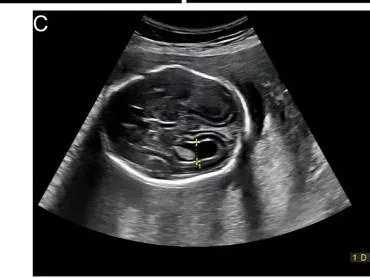 Ultrasound
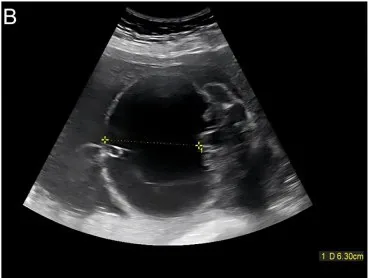 Ultrasound
Definition
- Congenital cytomegalovirus infection results from intrauterine transmission of cytomegalovirus (CMV, human herpesvirus 5) from the pregnant woman to the fetus.
Classification
- A distinction is made between maternal primary infection and non-primary infection due to reactivation or reinfection with a different CMV strain.
Occurrence & epidemiology
Initial Situation
- The pathogen: cytomegalovirus (CMV), a herpesvirus.
- Significance: most common congenital infection.
- Particularly useful for: women with toddlers (<3y) & daycare staff.
Epidemiology
- CMV is regarded as the most common viral cause of congenital infection and the leading cause of non-hereditary sensorineural hearing loss in children.
Aetiopathogenesis
Transmission and Risk
- Main route of transmission to the pregnant woman: saliva and urine of young children.
- Greatest risk of severe fetal damage: maternal primary infection in 1st trimester.
- Probability of transmission to the fetus: rises with gestational age, severity falls.
Aetiology and pathogenesis
- The virus is found in saliva, urine, genital secretions, breast milk and blood, among others; children shed it intermittently in urine and saliva.
- After primary infection in the first trimester, the virus is transmitted in about 20%, and more than half of infected fetuses suffer severe permanent damage.
Clinical features
What is seen in the child
- Ultrasound findings: microcephaly, periventricular calcifications.
- Also possible: growth restriction, hepatosplenomegaly.
- Confirmation of fetal infection: CMV PCR from amniotic fluid (after infection).
- Most common long-term sequela in a seemingly healthy newborn: progressive sensorineural hearing loss.
Clinical features and complications
- In immunocompetent pregnant women, infection is usually asymptomatic or causes non-specific, flu-like symptoms.
- 85–90% of congenitally infected newborns are asymptomatic at birth.
- Typical sequelae, often not yet recognisable after birth, are hearing impairment, delayed growth, intellectual disability and microcephaly.
Diagnosis
- Primary infection is ideally demonstrated by seroconversion; low-avidity IgG antibodies indicate infection within roughly the preceding three months.
- Prenatally, fetal infection is best detected by PCR of amniotic fluid, which may be falsely negative if performed too soon after infection.
- In the newborn, PCR detection of the virus in saliva or urine is the most sensitive method, as CMV IgM is undetectable in up to 80%.
Keep learning in the app
Further reading (selection)
Cross-references
Note: Learning content from the GynFuchs app (flashcards, exam questions, image cases) for medical education – not a treatment recommendation and no substitute for diagnosis or treatment decisions in individual cases. Treatment and management are deliberately not covered on this page.