Cervical insufficiency
Exam relevance: in 19 of 197 board exam reports · rank 36
- Specialty
- Obstetrics · Pregnancy disorders
- Images
- Ultrasound 3
- Exam relevance
- 19 of 197 reports · rank 36
- In the app
- 1 flashcards · GynFuchs
- Last updated
- 10/2026 · Dr. Pascal Bafteh
Contents
Images (3)
Definition
- Cervical insufficiency is painless dilatation of the cervix in the second or early third trimester without clinical contractions, caused by a functional or structural defect.
- It may be recognised in an ongoing pregnancy but is often diagnosed retrospectively.
Classification
- The diagnosis may be examination-based (physical examination), history-based (previous second-trimester losses) or ultrasound-based.
Occurrence & epidemiology
Epidemiology
- Estimated incidence varies greatly, from 1 in 100 to 1 in 2,000 pregnancies; the overall risk of a recurrent loss is probably no more than 30%, highest after at least two second-trimester losses.
Aetiopathogenesis
Aetiology and risk factors
- The cause is not fully understood; an interplay of structural changes and biochemical factors such as inflammation and infection is assumed, which disrupts normal cervical remodelling and causes premature ripening.
Clinical features
More facts from the study questions
- Cervical length measurement is standardised for the transvaginal route.
- A full bladder or probe pressure can artificially elongate the cervix.
- Sludge is echogenic material in the amniotic fluid near the internal os.
- This finding is associated with an increased risk of intra-amniotic infection.
- The medical history is crucial for risk stratification.
- A history of late miscarriage or extreme preterm birth after painless cervical dilatation is typical.
- Asymptomatic cervical shortening alone is not yet cervical insufficiency.
- The definition of insufficiency also requires preterm contractions or dynamic dilatation.
Clinical features and complications
- Cervical insufficiency is often asymptomatic until preterm birth; some women first notice vaginal pressure, bleeding or spotting, non-specific abdominal or back pain or increased discharge.
- Dilatation can lead to PPROM, second-trimester loss or spontaneous preterm birth.
Diagnosis
How it is measured
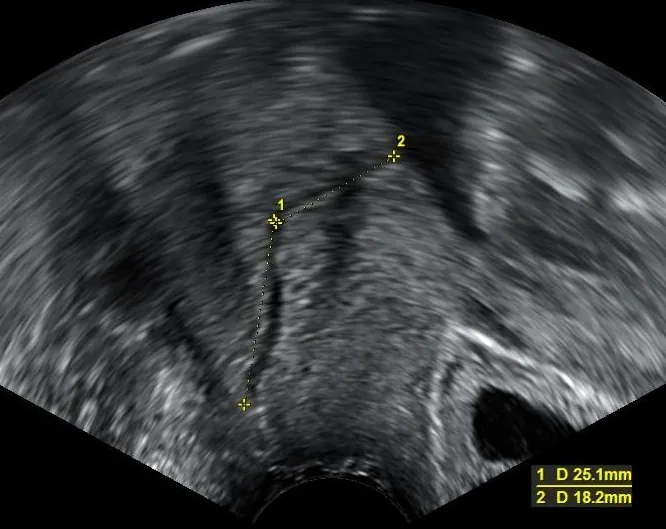
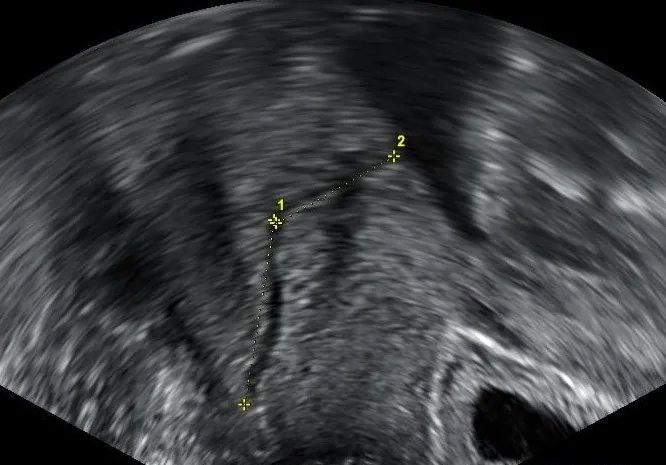
- Cervical length is measured transvaginally, no pressure, empty bladder.
- What is measured is the closed portion (internal to external os).
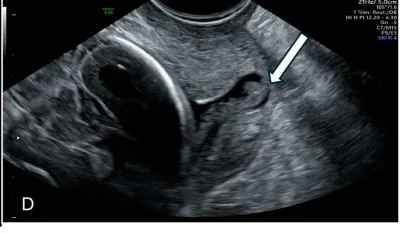
- Funnelling is opening of the internal os (T, Y, V, U shape).
- Sludge describes echogenic material in the lower amniotic space.
Numbers
- A cervix counts as short < 25 mm before 24+0 weeks.
- The shorter the cervix and the earlier the week, the higher the risk of preterm birth.
Shortening is not insufficiency
- Classic cervical insufficiency in the history appears as painless cervical dilatation in 2nd trimester.
- In women with symptoms or risk factors, cervical length is measured transvaginally between 15–16 and 23–24 weeks; suggestive findings are shortening to 25 mm or less with a relevant history, dilatation of the cervical canal and protrusion of the membranes into the cervical canal.
- On examination the cervix may be soft, effaced or dilated.
Keep learning in the app
Further reading (selection)
Cross-references
Note: Learning content from the GynFuchs app (flashcards, exam questions, image cases) for medical education – not a treatment recommendation and no substitute for diagnosis or treatment decisions in individual cases. Treatment and management are deliberately not covered on this page.