Phyllodes tumour
Exam relevance: in 1 of 197 board exam reports · rank 171
- Specialty
- Gynaecology · Breast
- Images
- Endoscopy & gross 1
- Exam relevance
- 1 of 197 reports · rank 171
- Last updated
- 10/2026 · Dr. Pascal Bafteh
Contents
Images (1)
Definition
- Rare biphasic fibroepithelial tumour of the breast with a morphological continuum from benign to malignant, accounting for 0.3–1% of primary breast tumours.
Classification
- The WHO distinguishes benign, borderline and malignant tumours by nuclear atypia, stromal cellularity, mitoses, tumour margin and stromal overgrowth; 60–75% are benign.
- Benign tumours have fewer than 5 mitoses per 10 HPF, borderline tumours 5–9 and malignant tumours 10 or more.
Occurrence & epidemiology
Epidemiology
- Mainly women aged 40 to 50 years are affected; benign forms tend to occur at a younger age than borderline and malignant tumours.
Clinical features
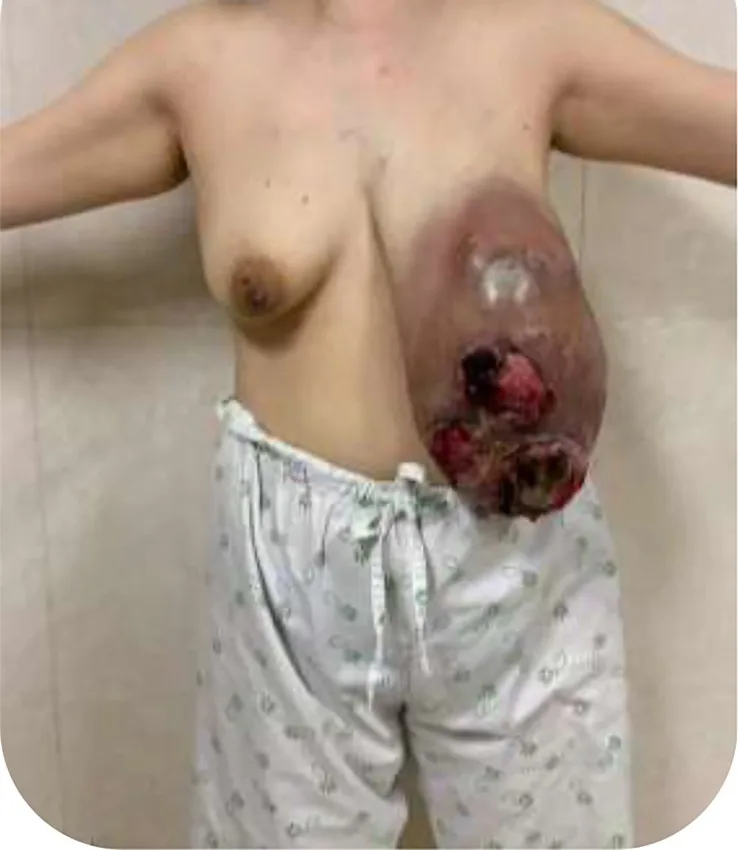
- Through rapid growth the tumour can bulge the breast, stretch the skin and ulcerate; dilated skin veins and nipple changes occur.
- Enlarged axillary lymph nodes are relatively common and usually reactive, whereas nodal metastases are very rare.
Histology
- Histology shows a hypercellular stroma with an increased intracanalicular growth pattern and leaf-like structures, lined by a double layer of epithelium, projecting into cystic spaces.
Diagnosis
- Mammography usually shows well-defined, dense masses; ultrasound shows a solid hypoechoic mass, usually with posterior acoustic enhancement and often increased vascularity on Doppler, cystic areas being more typical of malignant forms.
- Distinction from fibroadenoma is difficult, especially on core biopsy; imaging alone cannot reliably distinguish benign from malignant forms.
Keep learning in the app
Further reading (selection)
Cross-references
More topics: Breast
Note: Learning content from the GynFuchs app (flashcards, exam questions, image cases) for medical education – not a treatment recommendation and no substitute for diagnosis or treatment decisions in individual cases. Treatment and management are deliberately not covered on this page.