Missed miscarriage
Exam relevance: in 3 of 197 board exam reports · rank 125
- Specialty
- Obstetrics · Early pregnancy
- Images
- Ultrasound 2 · Colposcopy 1
- Exam relevance
- 3 of 197 reports · rank 125
- In the app
- 1 flashcards · GynFuchs
- Last updated
- 10/2026 · Dr. Pascal Bafteh
Contents
Images (3)
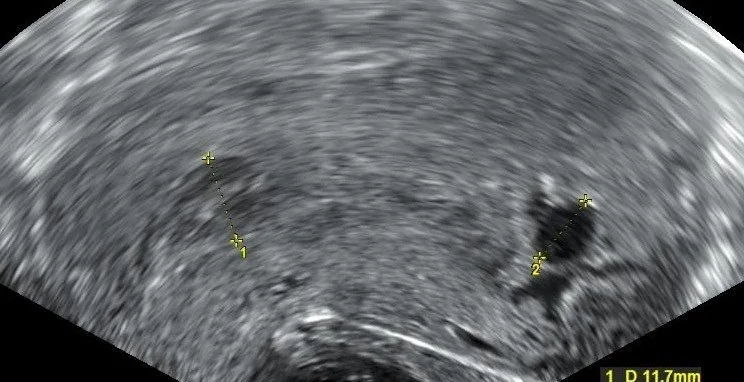 Ultrasound
 Colposcopy
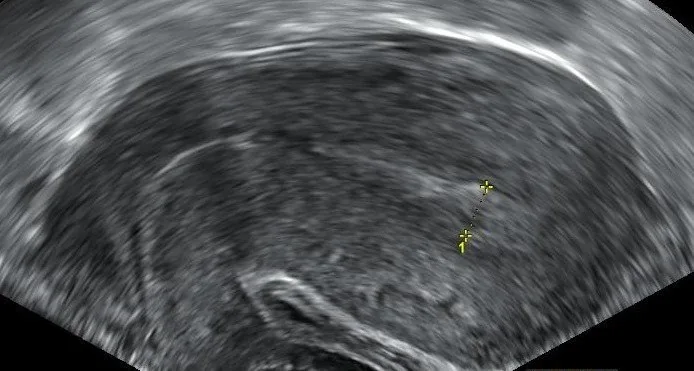 Ultrasound
Definition
Missed miscarriage and blighted ovum
- A missed miscarriage is a non-viable pregnancy without symptoms with a a closed cervix.
- A definitive ultrasound criterion for a missed miscarriage is a crown-rump length of CRL ≥7 mm without cardiac activity.
- A blighted ovum (anembryonic pregnancy) refers to a gestational sac without an embryonic pole.
- It denotes the death of the embryo or fetus without symptoms or expulsion of the products of conception (asymptomatic pregnancy loss).
- The cervix remains closed; vaginal bleeding is usually absent.
Classification
- A special form is the anembryonic pregnancy (formerly blighted ovum), in which a gestational sac forms and grows but an embryo fails to develop.
Occurrence & epidemiology
Epidemiology
- About 10–15% of confirmed pregnancies end in miscarriage, more than 80% of them in the first trimester.
- The risk depends strongly on age: in a large register study it was 10% at 25 to 29 years, 33% at 40 to 44 years and 57% above 45 years.
Aetiopathogenesis
Aetiology and risk factors
- Early miscarriages are often caused by chromosomal abnormalities of the embryo; frequently the cause remains unknown.
- Risk factors include very young or advanced maternal age, previous miscarriage, smoking, alcohol or cocaine use and poorly controlled chronic disease such as diabetes, hypertension or overt thyroid disease.
Clinical features
Clinical features and complications
- Many women are unaware of the loss, particularly in the early stages; it is then first detected on ultrasound.
Diagnosis
- Diagnostic ultrasound findings are a crown-rump length of at least 7 mm without cardiac activity or a mean sac diameter of at least 25 mm without an embryo.
- Also diagnostic is the absence of an embryo with cardiac activity at least 2 weeks after a scan showing a sac without a yolk sac, or at least 11 days after a scan showing a sac with a yolk sac.
- Many other findings of the gestational sac, yolk sac and embryo are suspicious but not diagnostic and need a repeat scan; no single hCG value proves pregnancy loss, whereas a fall over serial measurements is consistent with it.
Keep learning in the app
Further reading (selection)
Cross-references
Note: Learning content from the GynFuchs app (flashcards, exam questions, image cases) for medical education – not a treatment recommendation and no substitute for diagnosis or treatment decisions in individual cases. Treatment and management are deliberately not covered on this page.