Ovarian pregnancy
- Specialty
- Obstetrics · Early pregnancy
- Images
- Ultrasound 2
- In the app
- 1 flashcards · GynFuchs
- Last updated
- 10/2026 · Dr. Pascal Bafteh
Contents
Images (2)
Definition
- Ovarian pregnancy is one of the rarest forms of ectopic pregnancy, with implantation in the ovary.
Classification
Pregnancy in scars and on the ovary
- A caesarean scar pregnancy carries the risk of uterine rupture and a subsequent a placenta accreta spectrum.
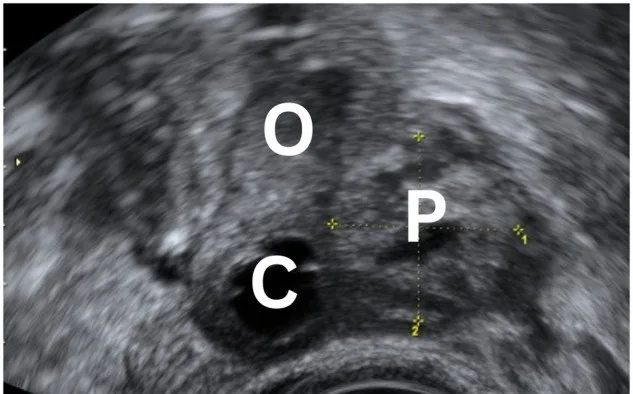
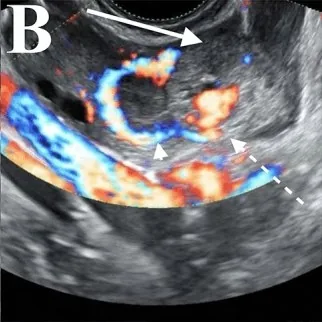
- An ovarian pregnancy is often misdiagnosed as a a ruptured corpus luteum cyst.
Occurrence & epidemiology
Epidemiology
- It accounts for about 3% of all ectopic pregnancies; the incidence in spontaneous pregnancies ranges from 1 in 2,000 to 1 in 60,000.
Aetiopathogenesis
Aetiology and risk factors
- Frequent associations are intrauterine devices, previous ectopic pregnancy, endometriosis, tubal lesions, pelvic inflammatory disease and chlamydia infection.
- Intrauterine devices reduce intrauterine and tubal implantation but not ovarian implantation.
Clinical features
Clinical features and complications
- Clinically there is moderate to severe pelvic or abdominal pain and vaginal bleeding with a positive pregnancy test; the course is acute in 90%.
- The natural course usually ends towards the end of the first trimester with rupture and haemoperitoneum.
Histology
- The diagnosis is confirmed by the Spiegelberg criteria: ipsilateral tube including the fimbriae intact and separate from the ovary, gestational sac in the ovarian cortex, ovary in its normal position attached to the uterus by the utero-ovarian ligament, and placental villi in the ovarian cortex on histology.
Diagnosis
- On ultrasound, ovarian pregnancy is hard to distinguish from a corpus luteum, haemorrhagic cyst or ruptured tubal pregnancy; the definitive diagnosis is made by histopathological examination.
Keep learning in the app
Further reading (selection)
Cross-references
Note: Learning content from the GynFuchs app (flashcards, exam questions, image cases) for medical education – not a treatment recommendation and no substitute for diagnosis or treatment decisions in individual cases. Treatment and management are deliberately not covered on this page.