Pregnancy of unknown location (PUL)
Exam relevance: in 3 of 197 board exam reports · rank 125
- Specialty
- Obstetrics · Early pregnancy
- Images
- Ultrasound 1
- Exam relevance
- 3 of 197 reports · rank 125
- In the app
- 1 flashcards · GynFuchs
- Last updated
- 10/2026 · Dr. Pascal Bafteh
Contents
Images (1)
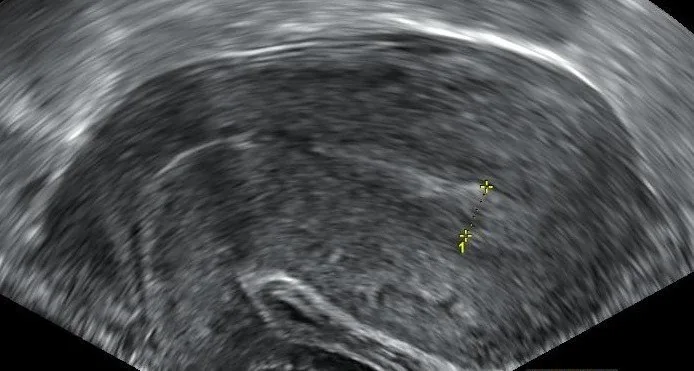
Definition
Definition and possible outcomes
- A pregnancy of unknown location (PUL) is present when there is a positive pregnancy test and a measurable beta-hCG level, but an ultrasound scan shows no intra- or extrauterine gestational sac is visible.
- A rare course is a persistent PUL, in which the location remains unclear in the further course.
- A pregnancy of unknown location (PUL) is present when the pregnancy test is positive but transvaginal ultrasound cannot locate the pregnancy either inside or outside the uterus.
- It is a classification, not a diagnosis.
Classification
- Final outcomes are: intrauterine pregnancy (viable or non-viable), failed pregnancy of unknown location (failed PUL), ectopic pregnancy and persisting PUL.
- A persisting PUL is commonly defined as more than three serial hCG values changing by less than 15% while the pregnancy still cannot be located on ultrasound.
Occurrence & epidemiology
Epidemiology
- The proportion of early pregnancies initially classified as PUL ranges from 8% to 42% between units; a low proportion indicates good quality of early pregnancy ultrasound.
- Most PULs end as a failed PUL (47–70%), fewer as an intrauterine pregnancy (17–41%) or an ectopic pregnancy (8–16%).
Clinical features
Clinical features and complications
- Many patients present with lower abdominal pain or vaginal bleeding; however, these symptoms do not identify which PULs carry a high risk of complications.
Diagnosis
- Single hCG measurements are of little value; the key parameter is the hCG ratio, the 48-hour value divided by the initial value.
- A ratio below 0.87 (a fall of at least 13%) points to a failed PUL, a ratio above 1.66 to an intrauterine pregnancy; values in between are more consistent with an ectopic pregnancy or persisting PUL.
- A serum progesterone of 10 nmol/L or less is associated with a failing pregnancy; progesterone predicts viability but not location.
- A single hCG discriminatory zone is not suitable for presuming an ectopic pregnancy.
Keep learning in the app
Further reading (selection)
Cross-references
Note: Learning content from the GynFuchs app (flashcards, exam questions, image cases) for medical education – not a treatment recommendation and no substitute for diagnosis or treatment decisions in individual cases. Treatment and management are deliberately not covered on this page.