Genital herpes
For patients: easy-to-read leaflets in English (page in German) →
- Specialty
- Dermatology · Sexually transmitted infections
- Images
- Clinical 1
- In the app
- 4 flashcards
- Last updated
- 10/2026 · Dr. Pascal Bafteh
Contents
Images (1)
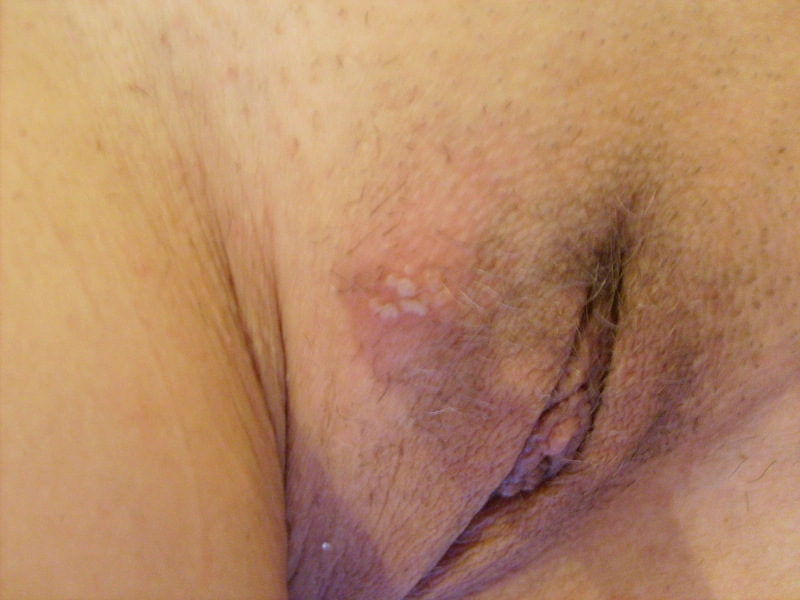
Definition
Primary infection (primary genital herpes)
- Course: the first genital infection runs asymptomatically in almost two thirds — many transmitters do not know they are infected.
- Clinical picture: after a non-specific prodrome there appear grouped vesicles on an erythematous, oedematous base that turn turbid, erode and crust within a polycyclic margin, together with fever, malaise and vomiting.
- Lymph nodes: regional lymphadenitis with enlarged, firm and tender nodes — unlike the painless swelling of a syphilitic chancre.
- Women: dysuria and voiding problems; in up to 15 % urinary retention forces suprapubic bladder catheterisation.
- Healing: a crust stage, then scarless healing within 8–12 days; the severity of the primary infection correlates with the later recurrence rate.
Recurrence (secondary HSV infection)
- Prodrome: tightness, itch, sometimes pain usually herald the recurrence, typically 2–5 days after trigger factors.
- Course: markedly milder than the primary infection, lymph nodes involved only occasionally; besides the genitals the buttocks, thighs, suprapubic and perianal skin may be affected.
- Frequency: recurrences occur about 5 times a year with HSV-2 and about once a year with HSV-1, most densely in the first year after the primary infection.
- Atypical presentations: folliculitis, an isolated fissure, erosion or plain oedema; herpes recidivans in loco always returns to the very same site.
Aetiopathogenesis
Pathogen & Transmission
- Pathogen: herpes simplex virus; genital herpes is caused by HSV-2 in 80–90 %, HSV-1 in 10–20 % (Braun-Falco 2018, p. 107). Sources disagree: DermNet NZ (2015) gives HSV-2 in only about 60–70 % of primary genital infections; in young women, a US study found HSV-1 to be the more common cause of primary genital infection (Bernstein et al. 2013).
- Forms: the term covers herpetic vulvovaginitis, cervicitis, urethritis, balanoposthitis and proctitis; the penile shaft and the gluteal, perineal and perianal regions are included as well.
- Transmission: direct skin/mucosal contact during intercourse, auto- and hetero-inoculation (herpetic whitlow), vertical transmission during birth.
- Latency & triggers: the virus persists in the sacral spinal ganglia; recurrences are triggered by menstruation, mechanical trauma (tight clothing, intercourse), physical exertion and stress.
- Why it matters: HSV-2 infection raises the risk of acquiring HIV roughly threefold; the lesions contain many CD4-positive target cells.
Diagnosis
Diagnostics
- Serology (gG-1/gG-2): only for special questions — assessment of partners (including in pregnancy), STI screening, a history of genital herpes without a current lesion. It cannot establish a primary infection, because the type-specific response takes months to build up.
- Less suitable: viral culture (about 48 h, sensitivity falls with the age of the lesion) and the Tzanck smear, which is simple but non-specific and yields neither the virus type nor the distinction from varicella zoster virus.
Differential diagnoses
Image credits for the thumbnails
- Secondary syphilis (lues II): Ehlers S, Sergent S, Ashurst J (Clin Pract Cases Emerg Med 2020), CC BY 4.0, via PubMed Central (PMC7676796) · CC BY 4.0 · Source
- Scabies: Gzzz, “Scabies hand and fingers 1”, CC BY-SA 4.0, via Wikimedia Commons · CC BY-SA 4.0 · Source
- Psoriasis vulgaris (plaque psoriasis): MediaJet, “An Arm Covered With Plaque Type Psoriasis”, CC BY-SA 3.0, via Wikimedia Commons · CC BY-SA 3.0 · Source
- Lichen sclerosus: Frucht CS, Ragsdale BD, Cureus 2026, Figure 1, CC BY 4.0, via PubMed Central (PMC13614091) · CC BY 4.0 · Source
Treatment principles
- Treatment is with systemic antivirals started as early as possible; the first episode is treated for longer than recurrences, for which short-course regimens suffice.
- With frequent recurrences, suppressive therapy with regular reassessment is possible, and in severe disease or immunosuppression, antivirals are given intravenously.
- Topical antivirals are ineffective, and drying local measures may be used; sexual partners are informed and other sexually transmitted infections are excluded.
Specific treatment regimens with drugs and doses are covered in the DermaFuchs app.
Keep learning in the app
References (selection)
Cross-references
More sexually transmitted infections
Keep learning
Keep learning with flashcards, exam questions and spot diagnoses in the DermaFuchs app – free, in your browser or as an app.
Related pages: Secondary syphilis (lues II) · Scabies · Psoriasis vulgaris (plaque psoriasis)
Note: This page is intended for medical education and does not replace diagnosis or treatment decisions in individual cases.