Primary cutaneous aggressive epidermotropic CD8-positive cytotoxic T-cell lymphoma
- Synonyms
- CD8-positives kutanes T-Zell-Lymphom, aggressives epidermotropes zytotoxisches T-Zell-Lymphom, CD8+ T-Zell-Lymphom der Haut, primary cutaneous CD8+ aggressive epidermotropic cytotoxic T-cell lymphoma, aggressive epidermotropic cytotoxic T-cell lymphoma
- Specialty
- Dermatology · Skin tumours
- Images
- Clinical 1 · Histology 1
- In the app
- 1 flashcards
- Last updated
- 10/2026 · Dr. Pascal Bafteh
Contents
Images (2)
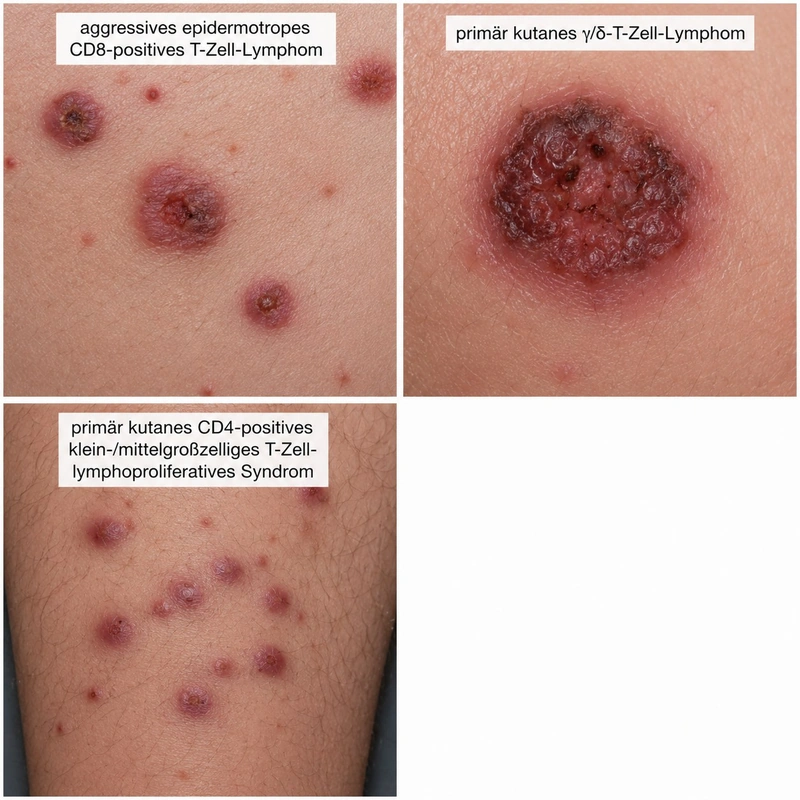 AI illustration
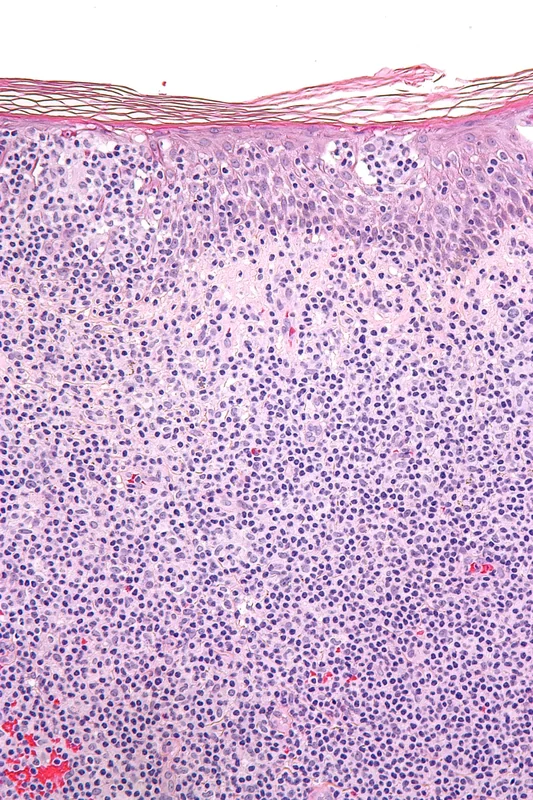 Histology
Definition
A rare primary cutaneous T-cell lymphoma of cytotoxic CD8-positive T cells with marked epidermotropism and an aggressive clinical course. "Primary cutaneous" means that no disease outside the skin is detectable at diagnosis. In the 2016 WHO classification it was listed as a provisional entity.
Occurrence & epidemiology
Very rare. In a US multicentre series (34 patients) the median age was 77 years (range 19–89 years).
Clinical features
- Generalised patches, plaques, papulonodules and tumours; mainly extensive annular necrotic plaques or tumours, frequently with mucosal involvement.
- In half of the patients in the US series (17 of 34), chronic patches preceded the disease and were often misdiagnosed as eczema, psoriasis or mycosis fungoides.
- Spread to unusual sites such as the lung, testis, central nervous system and oral cavity, but not to lymph nodes in the original description.
- Aggressive course: in the US series, 5-year survival was 32% and median survival 12 months.
Histology
Band-like infiltrates of pleomorphic T cells or immunoblasts diffusely infiltrating an acanthotic epidermis, with variable spongiosis, intraepidermal blistering and necrosis. Immunophenotype: CD3, CD8, CD7, CD45RA, betaF1 and TIA-1 positive, frequent loss of CD2 and CD5, high Ki-67 proliferation index. Because some cases lack CD8 or alpha-beta T-cell receptor expression with an identical picture, the broader term "aggressive epidermotropic cytotoxic T-cell lymphoma" has been proposed.
Diagnosis
- Skin biopsy with immunohistochemistry; clinicopathological correlation is decisive.
- CD8 positivity alone does not establish the entity: in the original description, 9 of 17 CD8-positive cutaneous T-cell lymphomas corresponded to other types (including mycosis fungoides, pagetoid reticulosis, lymphomatoid papulosis).
- Staging to exclude extracutaneous disease at diagnosis.
Differential diagnoses
- Mycosis fungoides
- Primary cutaneous diffuse large B-cell lymphoma (NOS)
- Primary cutaneous anaplastic large cell lymphoma
- Cutaneous metastases
- Subcutaneous Panniculitis-like T-Cell Lymphoma
- Extranodal NK/T-cell lymphoma (nasal type)
Keep learning in the app
References (selection)
- PubMed: Primary cutaneous CD8-positive epidermotropic cytotoxic T cell lymphomas. A distinct clinicopathological entity with an aggressive clinical behavior (PMID 10433941)
- PubMed: Primary cutaneous aggressive epidermotropic cytotoxic T-cell lymphomas: reappraisal of a provisional entity in the 2016 WHO classification of cutaneous lymphomas (PMID 28128277)
- PubMed: The 2018 update of the WHO-EORTC classification for primary cutaneous lymphomas (PMID 30635287)
- PubMed: Primary cutaneous aggressive epidermotropic CD8+ T-cell lymphoma: proposed diagnostic criteria and therapeutic evaluation (PMID 22226429)
Cross-references
Note: This page is intended for medical education and does not replace diagnosis or treatment decisions in individual cases.