Asteatotic eczema (winter eczema, eczema craquelé)
- Synonyms
- Winter eczema, eczema craquelé, xerotic eczema, asteatotic dermatitis, Exsikkationsekzem
- Specialty
- Dermatology · Allergies
- Last updated
- 10/2026 · Dr. Pascal Bafteh
Contents
Definition
Asteatotic eczema (winter eczema, xerotic eczema) is an eczema that develops on markedly dry skin (xerosis cutis). Its hallmark is a network of fine, reddened fissures in dry, scaly skin – resembling the cracked glaze of porcelain (French craquelé), crazy paving or a dried-out riverbed. It typically affects the lower legs of older people and worsens in the cold, dry season.
Classification
- By severity: xerosis cutis (dry skin without inflammation) → asteatotic eczema with inflamed fissures (eczema craquelé) → severe disease with secondary eczematisation, swelling and vesicles, rarely spreading as disseminated eczema (autosensitisation).
- By cause: commonly environmental and age-related (dry heated air, frequent washing, skin ageing); less often symptomatic of an underlying disease or caused by drugs – then often unusually extensive, of rapid onset or without a seasonal pattern.
Occurrence & epidemiology
- Asteatotic eczema is one of the most common forms of eczema in older age and occurs mainly in winter.
- The underlying xerosis cutis is very common in older people: in a French primary care study 55.6% of patients aged 65 or older had xerosis; in the population-based Rotterdam Study (middle-aged and elderly participants) 60% had dry skin, a fifth of them generalised. These figures describe dry skin, not the eczema itself.
- Factors associated with dry skin included older age, female sex, low outdoor temperature, body mass index, smoking, a history of eczema or atopic dermatitis and certain drugs (e.g. diuretics).
Aetiopathogenesis
- Barrier dysfunction: with age, stratum corneum lipids and sebum production decline; the horny layer loses water and suppleness, becomes brittle and cracks. Inflammation develops within the cracks – hence the red “grout lines” between the dry plates.
- External factors: low humidity (winter, central heating, fan heaters, high altitude), frequent and hot baths or showers, soaps and detergents, friction.
- Internal factors and associated conditions: ichthyoses (inherited or acquired), hypothyroidism (myxoedema), malnutrition (including zinc and fatty acid deficiency), marked weight loss, oedematous states (e.g. nephrotic syndrome), reduced skin sensation; rarely paraneoplastic, especially with lymphomas (including Hodgkin lymphoma in older patients).
- Drugs: including diuretics, retinoids, protein kinase inhibitors and some cytostatic agents (e.g. taxanes).
Clinical features
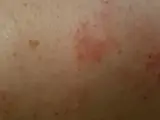
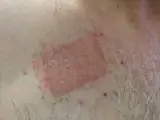
- Dry, finely scaling skin with a network of shallow, reddened fissures; between them polygonal to diamond-shaped plates of skin – the typical “craquelé” pattern.
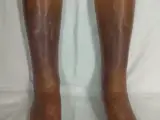
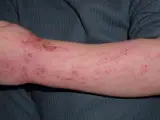
- Predilection sites: extensor aspects of the lower legs (shins), often bilateral after starting on one side; also extensor aspects of the arms, flanks and trunk, hands.
- Itch and burning, excoriations; deep fissures may bleed and hurt (haemorrhagic fissures).
- Complications: bacterial superinfection, secondary eczematisation with redness, swelling and vesicles, rarely disseminated spread.
- Course: worsening in winter, improvement in more humid months; recurrences are common without consistent emollient care.
- Dermoscopy (adjunct): white scales with a double free edge arranged in a linear pattern, resembling railway tracks.
Diagnosis
- Clinical diagnosis based on the typical appearance and distribution; in most patients no further tests are needed.
- History: bathing and showering habits, cleansing and skin care products, indoor climate, medication list (e.g. diuretics), weight trend and general symptoms.
- Targeted work-up: thyroid function tests if there are clinical signs of hypothyroidism; with recent, extensive or persistent disease – especially with marked scaling (acquired ichthyosis), weight loss, fever or night sweats – a search for an internal cause including lymphoma.
- If the course is atypical or treatment fails: fungal testing (tinea), patch testing (contact allergy to topical products), biopsy to distinguish e.g. mycosis fungoides or premonitory bullous pemphigoid. Histology shows a non-specific spongiotic dermatitis.
Differential diagnoses
Treatment principles
- The basis is consistent emollient skin care and reducing drying influences (frequency, duration and temperature of baths and showers, mild soap-free cleansing, indoor climate).
- Inflamed areas are treated briefly with topical glucocorticoids; antiseptic measures are added if there is superinfection.
- In symptomatic forms, treating the underlying disease or reviewing causative drugs takes priority; because relapses are common, basic skin care is continued long term.
Specific treatment regimens with drugs and doses are covered in the DermaFuchs app.
Keep learning in the app
References (selection)
- Srivastava D, Sathe NC, Persaud Y. Asteatotic Eczema. StatPearls, updated 01/2026 (PMID 31747214)
- Harries L et al. Eczema and its treatment in older adults [in German]. Dermatologie (Heidelb) 2023;74:678–686 (PMID 37638989)
- Paul C et al. Prevalence and risk factors for xerosis in the elderly: a cross-sectional epidemiological study in primary care. Dermatology 2011;223:260–265 (PMID 22104182)
- Mekić S et al. Prevalence and determinants for xerosis cutis in the middle-aged and elderly population: A cross-sectional study. J Am Acad Dermatol 2019;81:963–969 (PMID 30586613)
- Park JS et al. Acquired ichthyosis, asteatotic dermatitis or xerosis? An update on pathoetiology and drug-induced associations. J Eur Acad Dermatol Venereol 2023;37:47–56 (PMID 36165597)
- Le Clainche Compagnie A et al. Asteatotic eczema, a cutaneous manifestation of Hodgkin lymphoma in older patients. EJHaem 2024;5:883–884 (PMID 39157615)
- Patrizi A et al. Eczema craquelé, an uncommon clinical manifestation of myxedema. J Dtsch Dermatol Ges 2015;13:453–454 (PMID 25918092)
- Cassler NM et al. Asteatotic eczema in hypoesthetic skin: a case series. JAMA Dermatol 2014;150:1088–1090 (PMID 25029204)
- DermNet: Asteatotic eczema
Cross-references
Keep learning
Keep learning with flashcards, exam questions and spot diagnoses in the DermaFuchs app – free, in your browser or as an app.
Related pages: Nummular eczema (discoid eczema) · Stasis dermatitis (venous eczema) · Atopic dermatitis (atopic eczema)
Note: This page is intended for medical education and does not replace diagnosis or treatment decisions in individual cases.