Insect venom allergy
- Synonyms
- bee sting allergy, wasp sting allergy, hymenoptera venom allergy, insect sting allergy, venom allergy
- Specialty
- Internal medicine · Allergology
- Images
- Clinical 2
- Last updated
- 10/2026 · Dr. Pascal Bafteh
Contents
Images (2)
Definition
Insect venom allergy refers to allergic reactions to the venom of stinging insects of the order Hymenoptera. The venom causes a local toxic reaction in everyone; allergic reactions, in contrast, occur only in previously sensitised people. Their severity depends on the amount of venom and the degree of sensitisation.
Classification
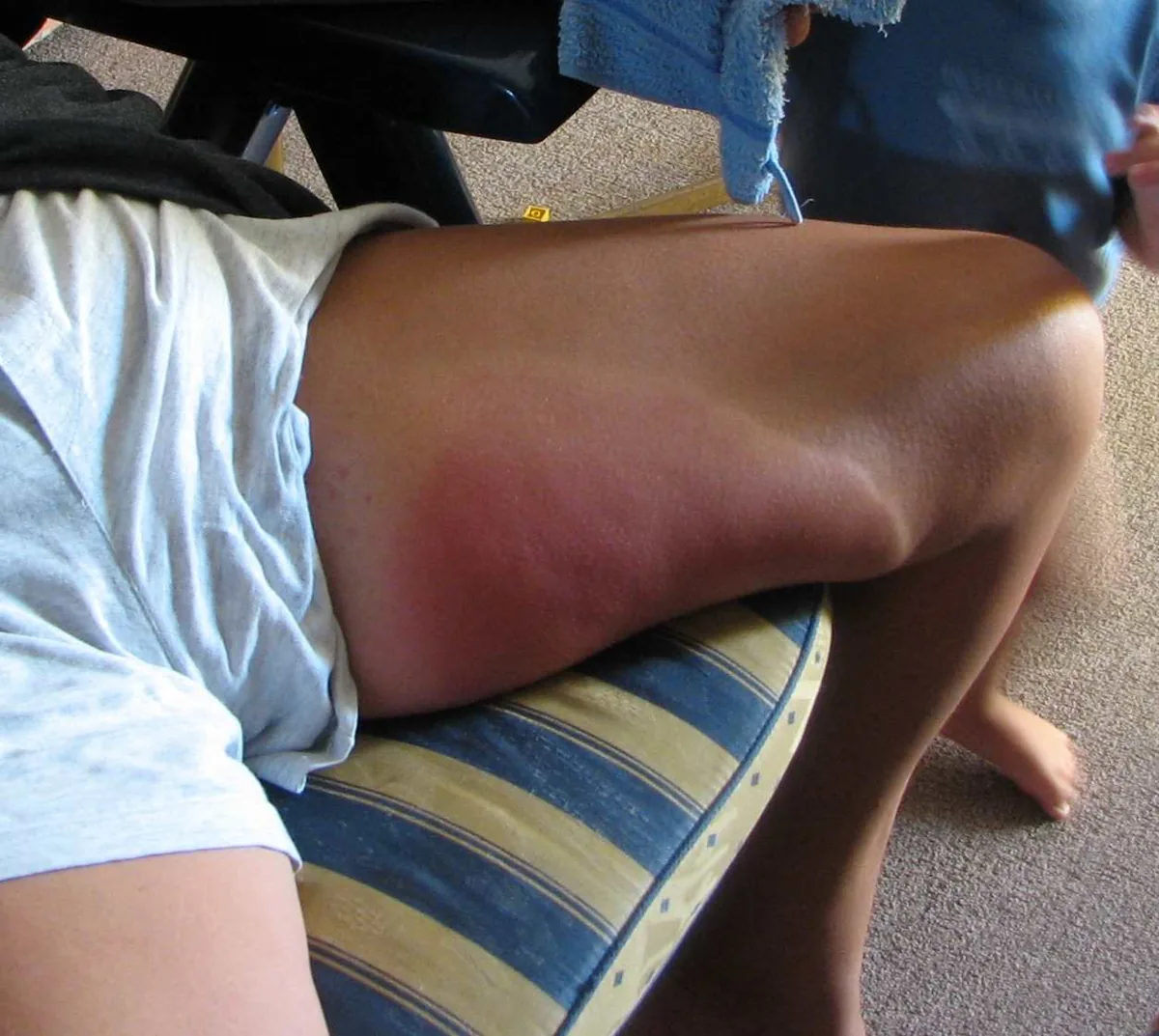
- Normal local reaction: immediate burning pain, itching, redness, swelling and induration of a few centimetres.
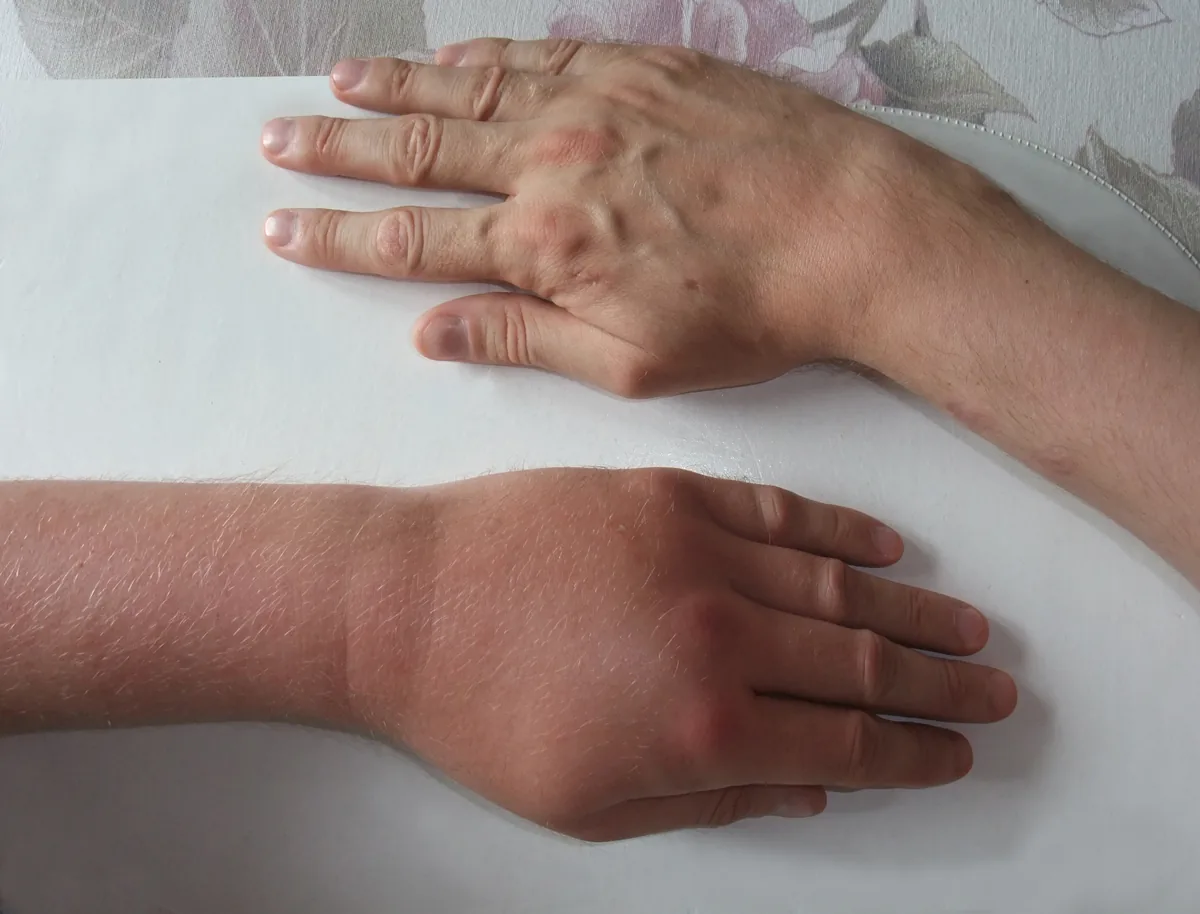
- Large local reaction: swelling and redness usually peak after about 48 hours, may persist for a week and may involve an entire limb; swelling alone is not a sign of an allergic reaction.
- Systemic allergic reaction: urticaria, angiedema, bronchospasm, persistent severe hypotension or a combination up to anaphylaxis.
- Toxic reaction from multiple stings: the average unsensitised person can tolerate about 22 stings per kilogram of body weight; in children, 500 stings can already be life-threatening.
Aetiopathogenesis
- Bees (apids): e.g. honeybees and bumblebees; they usually sting only when provoked and only once, as the barbed stinger with the venom apparatus remains in the skin. Melittin is thought to be the main pain-inducing component.
- Vespids: e.g. wasps and hornets; their stinger has few barbs, so they can sting repeatedly. The venom contains phospholipase, hyaluronidase and antigen 5, which is regarded as the most allergenic. Because they nest close to humans, encounters are frequent.
- Ants: above all fire ants, which are widespread in parts of the USA.
- Risk factors for anaphylaxis: swarm attacks and high venom-specific IgE levels; many affected children do not outgrow the risk. In mastocytosis, insect stings can trigger marked mast cell activation.
- Mechanism: type I reaction; venom-specific IgE on mast cells and basophils leads to mediator release on a further sting.
Clinical features
Locally, immediate burning pain, itching, redness and swelling occur. Systemic reactions present as generalised urticaria, angiedema, bronchospasm with breathlessness and circulatory reactions up to shock. Fire ant stings cause a wheal and flare that often resolves within about 45 minutes and gives rise to a sterile pustule. Mononeuritis and seizures have been reported. Secondary bacterial cellulitis is uncommon; it is suspected when redness and swelling begin only after one or two days, fever develops and pain is marked.
Diagnosis
- Clinical diagnosis: history of the sting, type of insect and examination of the sting site; after bee stings the stinger often remains. Upper and lower airways are assessed for signs of an allergic reaction.
- Serum tryptase: preferably within 2 hours of the onset of a systemic reaction; an elevation supports the diagnosis of anaphylaxis. A persistently raised baseline level may indicate a mast cell disorder.
- Skin tests: after a systemic reaction, intradermal testing in particular is used to confirm venom allergy; it is considered more sensitive than prick testing or serum IgE. A wheal at least 3 mm larger than the negative control after 15 to 20 minutes is positive.
- Venom-specific serum IgE: additionally, when skin tests are not possible or are equivocal.
Keep learning in the app
Further reading (open access)
Cross-references
Note: Learning content for medical education – not a treatment recommendation and no substitute for diagnosis or treatment decisions in individual cases. Treatment and management are deliberately not covered on this page.