Female urinary incontinence
Exam relevance: in 31 of 197 board exam reports · rank 25
- Synonyms
- urinary incontinence, bladder weakness
- Specialty
- Gynaecology · Pelvic floor & urogynaecology
- Images
- Clinical 2
- Exam relevance
- 31 of 197 reports · rank 25
- In the app
- 2 flashcards · GynFuchs
- Last updated
- 10/2026 · Dr. Pascal Bafteh
Contents
Images (2)
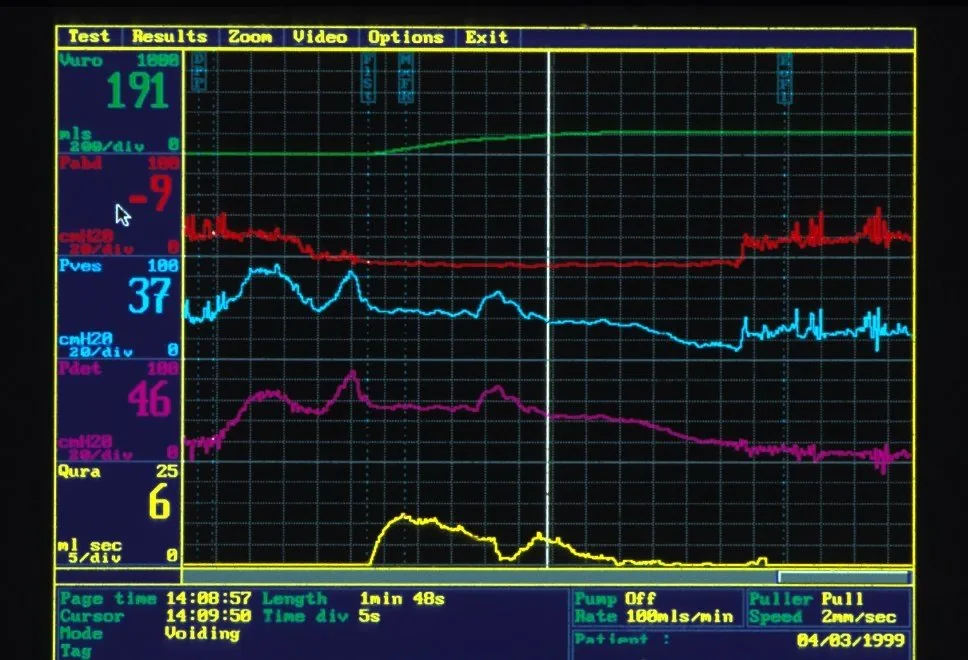
Classification
Three types — and what the patient describes
- Stress incontinence: urine leakage on coughing, sneezing, lifting, or exercising, without a preceding urge to urinate.
- Urge incontinence: a sudden, almost uncontrollable urge to urinate with urine loss, plus pollakiuria and nocturia.
- Mixed incontinence: both components are present — the question is which component is more bothersome to the patient.
- Frequency: stress incontinence accounts for about half, and the mixed form for about a third of cases.
Types you think of last
- Overflow incontinence: dribbling leakage with chronic retention and large residual urine volume.
- Extraurethral incontinence: constant leakage without urge and without stress — suggests a fistula.
- Nocturia: ask about it specifically — it is more indicative of an urge component than a stress component.
Clinical features
More facts from the study questions
- Stress incontinence accounts for about half of all cases.
- The mixed form accounts for about one third.
- An intrinsic sphincter deficiency is the correlate of a rigid, hypomobile urethra.
- The underlying mechanism of urge incontinence is involuntary contractions of the bladder muscle (detrusor vesicae muscle) during the filling phase.
- Risk factors for stress incontinence include vaginal births, macrosomic infants, obesity and chronic cough.
- The bladder diary is a key, simple diagnostic tool.
- It is kept for two to three days to objectify fluid intake and voiding patterns.
- The stress test (cough provocation) is performed with a comfortably full bladder.
- Immediate, visible urine leakage proves a stress incontinence component.
- Introital or perineal ultrasound is a dynamic examination.
Diagnosis
History
- First: type of urine loss, triggers, amount, pad usage, and the degree of suffering.
- Drinking and voiding habits: fluid intake volume, coffee, micturition frequency, nocturia, and urgency.
- The simplest tool: a bladder and fluid diary for two to three days.
Clinical Examination
- Speculum and palpation: descent per compartment, signs of atrophy, pelvic floor muscle strength according to the Oxford scale.
- Stress test: coughing with a full bladder — visible urine leakage at the same moment proves the stress component.
- Additionally in case of prolapse: elevation test to uncover occult stress incontinence.
- Always included: urine status with dipstick test and post-void residual volume measurement by sonography.
Sonography — Introitus and Perineum
- What is assessed: the mobility of the bladder neck and the urethrovesical angle during straining.
- Funnelling: a funnel-shaped opening of the proximal urethral lumen under stress.
- Mnemonic for the examination: scan before and after bladder emptying because the findings change with bladder filling.
- Advantage over urodynamics: immediately available, radiation-free, without a catheter, and without risk of infection.
Keep learning in the app
Further reading (selection)
Cross-references
Note: Learning content from the GynFuchs app (flashcards, exam questions, image cases) for medical education – not a treatment recommendation and no substitute for diagnosis or treatment decisions in individual cases. Treatment and management are deliberately not covered on this page.