Stress urinary incontinence
Exam relevance: in 25 of 197 board exam reports · rank 30
- Synonyms
- stress incontinence, SUI
- Specialty
- Gynaecology · Pelvic floor & urogynaecology
- Images
- Clinical 1
- Exam relevance
- 25 of 197 reports · rank 30
- In the app
- 1 flashcards · GynFuchs
- Last updated
- 10/2026 · Dr. Pascal Bafteh
Contents
Images (1)
Definition
- Sudden involuntary leakage of urine during activities that raise intra-abdominal pressure, such as exertion, sneezing, coughing, laughing or straining.
- Urine leaks when the pressure in the bladder exceeds the urethral closure pressure.
Classification
- Pathophysiologically, urethral hypermobility with descent of the bladder neck due to weakened supports is distinguished from intrinsic sphincter deficiency.
Occurrence & epidemiology
Epidemiology
- More than 60% of women experience urinary incontinence during their lifetime, more often after childbirth and with increasing age; in a US survey of over 15,000 women about 25% reported stress-only incontinence.
- Stress urinary incontinence is one of the most common types of incontinence in women.
Aetiopathogenesis
Why stress incontinence develops
- Basic mechanism: the urethral closure pressure falls below the bladder pressure during exertion.
- Structural correlate: the suburethral support from fascia, ligaments, and the levator ani no longer supports the bladder neck.
- Risk factors: vaginal births, macrosomic babies, obesity, chronic cough, oestrogen deficiency, heavy physical labour.
Aetiology and pathogenesis
- The primary support of the bladder neck and urethra is the levator ani muscle complex.
- Risk factors in women include pregnancy, multiple vaginal births, menopause and obesity; further modifiable factors are smoking and chronic constipation.
Clinical features
More facts from the study questions
- Stress incontinence accounts for about half of all cases.
- The mixed form accounts for about one third.
- An intrinsic sphincter deficiency is the correlate of a rigid, hypomobile urethra.
- The underlying mechanism of urge incontinence is involuntary contractions of the bladder muscle (detrusor vesicae muscle) during the filling phase.
- Risk factors for stress incontinence include vaginal births, macrosomic infants, obesity and chronic cough.
- Leakage occurs during activities that raise pressure, such as coughing, sneezing, laughing or exertion.
- Pelvic organ prolapse, common after menopause or childbirth, is often associated with stress incontinence.
Diagnosis
- A bladder diary is a valuable aid; in the cough stress test with a full bladder, leakage from the urethra at the moment of coughing confirms stress incontinence.
- In the Q-tip test, an angle change of 30° or more on straining indicates urethral hypermobility.
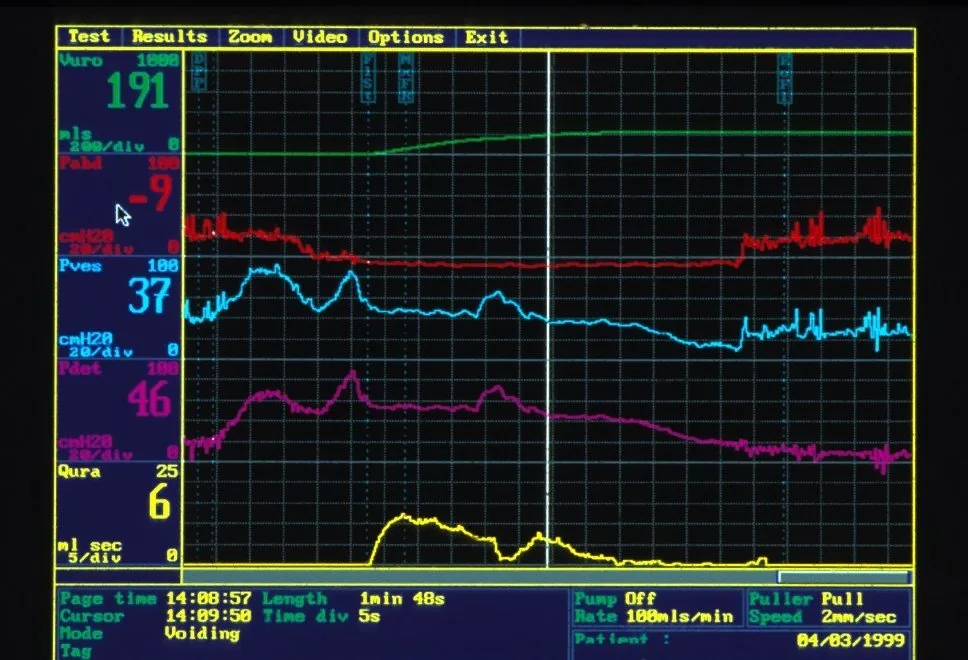
- Urodynamic assessment includes post-void residual measurement, urethral pressure profile and leak point pressure; a maximum urethral closure pressure below 20 cmH2O is associated with intrinsic sphincter deficiency.
- An abdominal leak point pressure below 60 cmH2O suggests intrinsic sphincter deficiency or a short functional urethral length, values above 90–100 cmH2O stress incontinence due to hypermobility.
- In the pad test, urine loss is quantified by weighing a pad before and after specified activities; in the one-hour test a weight gain of 1 g is considered significant.
Keep learning in the app
Further reading (selection)
Cross-references
Note: Learning content from the GynFuchs app (flashcards, exam questions, image cases) for medical education – not a treatment recommendation and no substitute for diagnosis or treatment decisions in individual cases. Treatment and management are deliberately not covered on this page.