Abnormal uterine bleeding
Exam relevance: in 33 of 197 board exam reports · rank 20
- Synonyms
- heavy menstrual bleeding, irregular periods, AUB
- Specialty
- Gynaecology · Endocrinology & cycle
- Images
- Endoscopy & gross 1 · Ultrasound 1
- Exam relevance
- 33 of 197 reports · rank 20
- In the app
- 4 flashcards · GynFuchs
- Last updated
- 10/2026 · Dr. Pascal Bafteh
Contents
Images (2)
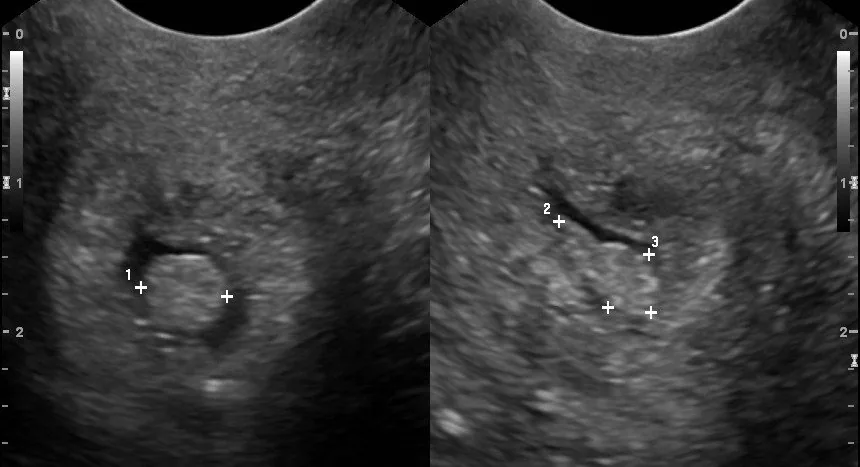 Endoscopy & gross
 Ultrasound
Definition
Normal Cycle as a Benchmark
- Normal cycle length: 24 to 38 days.
- Normal duration of bleeding: up to 8 days.
- Normal blood loss: 30 to 80 ml per period.
- How to assess the amount in practice: pad/tampon use, presence of clots.
Classification
Rhythm Disorders
- Oligomenorrhoea: cycle interval > 38 days.
- Polymenorrhoea: cycle interval < 24 days.
- Primary amenorrhoea: menstruation has never occurred.
- Secondary amenorrhoea: absence for > 3 months.
Disorders of Amount and Duration
- Hypermenorrhoea: excessively heavy bleeding (> 80 ml/cycle).
- Hypomenorrhoea: abnormally light menstrual bleeding.
- Menorrhagia: excessively long bleeding (> 8 days).
- Metrorrhagia: acyclic, continuous bleeding without rhythm.
- Additional bleeding: intermenstrual bleeding.
- Postmenopausal bleeding: bleeding after > 12 months of amenorrhea.
Special Cases
- Dysmenorrhoea: painful menstruation.
- Contact bleeding: bleeding after intercourse/exam.
- What any postmenopausal bleeding necessitates: an etiological workup.
Aetiopathogenesis
Idea Behind the Acronym
- What PALM-COEIN classifies: causes of AUB in non-pregnant women.
- The dividing line in the acronym: PALM: structural, COEIN: non-structural causes.
PALM — The Structural Causes
- P: polyp (endometrial/cervical).
- A: adenomyosis uteri.
- L: leiomyoma (FIGO classified).
- M: malignancy and hyperplasia.
- Which fibroids typically cause heavy bleeding: submucosal and cavity-distorting.
COEIN — The Non-Structural Causes
- C: coagulopathy.
- O: ovulatory dysfunction.
- E: endometrial dysfunction.
- I: iatrogenic causes.
- N: not yet classified.
- The most common underlying coagulation disorder: von Willebrand disease.
Anovulatory Bleeding
- What is missing: ovulation and progesterone phase.
- Consequence for the endometrium: unstable proliferation due to estrogen.
- Typical life stages: years after menarche and perimenopause.
- The classic endocrine cause in middle age: PCOS with chronic anovulation.
Clinical features
Adolescent
- Most common cause of irregular bleeding in the first few years: anovulation with immature HPO axis.
- What still needs to be investigated: heavy or anaemia-inducing bleeding.
- To be ruled out above all: coagulopathy (esp. von Willebrand).
- In case of primary amenorrhoea with cyclical pain: outflow obstruction (hymen, vaginal septum).
- Examination in this age group: inspection, abdominal ultrasound.
Perimenopausal Woman
- Why bleeding becomes irregular: anovulatory cycles, oestrogen fluctuation.
- In case of endometrial thickening with a bleeding disorder: hysteroscopy with fractional curettage.
More facts from the study questions
- Secondary amenorrhoea is the absence of menstruation for more than three months in a woman who has previously had cycles.
- Polymenorrhoea is a tempo anomaly.
- It is characterised by shortened cycle intervals of less than 24 days.
- Bleeding that occurs after sexual intercourse or a gynaecological examination is termed contact bleeding.
- It always requires investigation, starting with inspection of the cervix.
- Oligomenorrhoea is a tempo anomaly.
- It is defined by prolonged cycle intervals of more than 38 days.
- Menorrhagia is excessively prolonged bleeding (lasting more than about eight days).
- Excessively heavy bleeding is termed hypermenorrhoea (heavy menstrual bleeding).
- The 'P' in the PALM acronym stands for polyps, which can occur in both the endometrium and the cervix.
Keep learning in the app
Further reading (selection)
Cross-references
Note: Learning content from the GynFuchs app (flashcards, exam questions, image cases) for medical education – not a treatment recommendation and no substitute for diagnosis or treatment decisions in individual cases. Treatment and management are deliberately not covered on this page.