Hirsutism and hyperandrogenism
Exam relevance: in 5 of 197 board exam reports · rank 101
- Synonyms
- hirsutism, excess hair growth
- Specialty
- Gynaecology · Endocrinology & cycle
- Images
- Clinical 1
- Exam relevance
- 5 of 197 reports · rank 101
- In the app
- 1 flashcards · GynFuchs
- Last updated
- 10/2026 · Dr. Pascal Bafteh
Contents
Images (1)
Definition
Differentiating the Terms
- Hirsutism: terminal hair at androgen-dependent sites.
- Hypertrichosis: androgen-independent hair growth, often drug-induced.
- Virilisation: hirsutism plus clitoromegaly, voice deepening.
- How hirsutism is graded: using the Ferriman-Gallwey score (9 body regions).
- What rapid progression with virilisation means: suspicion of androgen-producing tumor (urgent workup!).
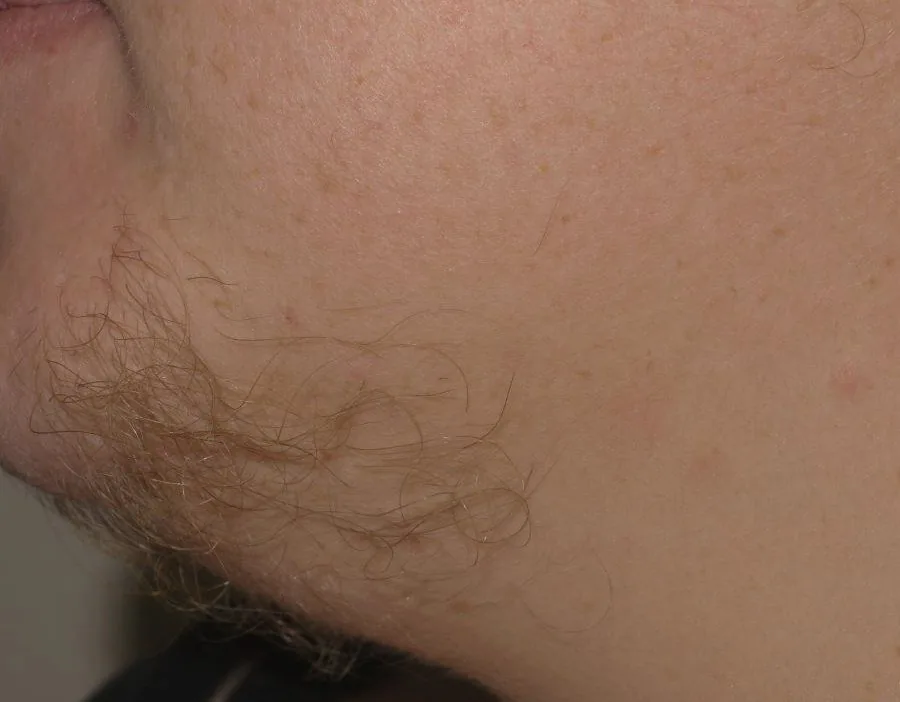
- Hirsutism is excessive growth of thick, dark hair in a male pattern in women after puberty, for example in the beard and moustache area, on the chest, back, lower abdomen and inner thighs.
- It results from raised circulating androgen levels or increased androgen sensitivity of the hair follicles; severity therefore does not correlate closely with androgen levels.
Occurrence & epidemiology
Epidemiology
- Hirsutism is common and is estimated to affect nearly 10% of women in the United States; what is considered excessive depends on ethnic background and cultural perception.
Aetiopathogenesis
Aetiology and pathogenesis
- The most common cause is polycystic ovary syndrome.
- Non-classic congenital adrenal hyperplasia is almost always due to 21-hydroxylase deficiency with increased production of 17-hydroxyprogesterone and androstenedione and may clinically resemble PCOS.
- Androgen-secreting ovarian and adrenal tumours are rare causes; they typically cause rapidly progressive hirsutism later in life, adrenal carcinomas often together with Cushing syndrome.
- Further causes include Cushing syndrome, acromegaly, hyperprolactinaemia, ovarian hyperthecosis and androgenic substances such as anabolic agents.
- Idiopathic hirsutism, with normal androgen levels, regular menses and no identifiable cause, is a diagnosis of exclusion; it is found in about half of women with mild hirsutism.
Clinical features
- Acne, menstrual irregularities and androgenetic alopecia are often associated; acanthosis nigricans points to hyperinsulinaemia, for example in PCOS.
- Abrupt onset, rapid progression, onset later in life or signs of virilisation such as clitoromegaly, deepening of the voice, increased muscle mass and male-pattern baldness point to an androgen-secreting tumour.
Diagnosis
Laboratory Tests
- Basic parameters: total testosterone, SHBG, DHEAS, androstenedione.
- Why SHBG is also measured: to estimate free, biologically active testosterone.
- What lowers SHBG levels: obesity and insulin resistance (increases free T.).
- A markedly elevated DHEAS points to: to an adrenal cause.
- To rule out adrenogenital syndrome: 17-hydroxyprogesterone (early follicular phase).
- Severity is quantified with the Ferriman-Gallwey score, which rates nine androgen-sensitive body areas from 0 to 4 each.
- Baseline tests include free and total testosterone, DHEAS, LH and FSH, plus prolactin if menses are irregular; 17-hydroxyprogesterone is measured if congenital adrenal hyperplasia is suspected.
- High testosterone with normal DHEAS suggests an ovarian source, and additionally raised DHEAS an adrenal source.
Keep learning in the app
Further reading (selection)
Cross-references
Note: Learning content from the GynFuchs app (flashcards, exam questions, image cases) for medical education – not a treatment recommendation and no substitute for diagnosis or treatment decisions in individual cases. Treatment and management are deliberately not covered on this page.