HPV infection
Exam relevance: in 27 of 197 board exam reports · rank 29
- Synonyms
- human papillomavirus, HPV
- Specialty
- Gynaecology · Cervix & HPV
- Images
- Clinical 3 · Histology & cytology 1
- Exam relevance
- 27 of 197 reports · rank 29
- In the app
- 1 flashcards · GynFuchs
- Last updated
- 10/2026 · Dr. Pascal Bafteh
Contents
Images (4)
 Histology & cytology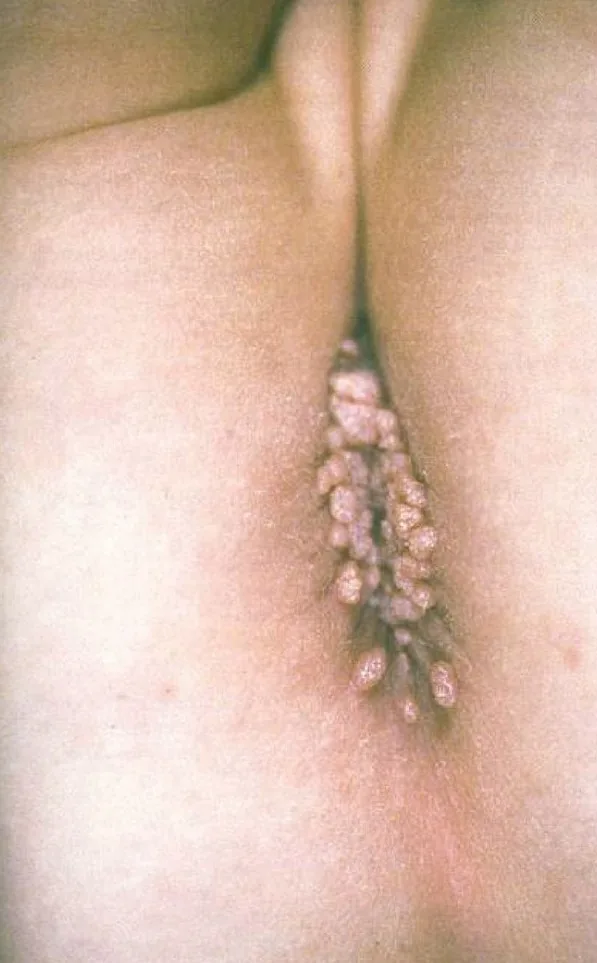
Definition
- HPV infection is an infection of cutaneous or mucosal epithelial cells by human papillomaviruses.
- HPV is the most common sexually transmitted infection; anogenital types can also reach the oropharynx through orogenital contact.
Classification
HPV types
- High-risk types most often expected: 16 and 18, plus 31, 33, 45, 52, 58.
- Low-risk types and their typical disease: 6 and 11 — condylomata acuminata.
- HPV 16 and 18 together cause roughly 70 % of cervical cancers.
- More than 100 HPV types are known; most infect the skin and cause skin warts, while others mainly infect the mucosa of the anogenital region and of the oropharynx and larynx.
- The low-risk types 6 and 11 most often cause anogenital warts as well as laryngeal and oropharyngeal warts.
- Virtually all cervical cancers are caused by HPV: about 70 % are due to HPV 16 and 18, and many of the rest to the high-risk types 31, 33, 45, 52 and 58.
Occurrence & epidemiology
Epidemiology
- Almost all sexually active people are infected with HPV at some point in their lives, usually without symptoms.
- Infection usually has no lasting effects: the immune system generally clears HPV within a year or two.
- Persistent infection with high-risk types causes cervical cancer and is associated with cancers of the vulva, vagina, mouth and throat, penis and anus; cervical cancer is the most common HPV-related cancer and accounts for over 90 % of HPV-related cancers in women.
Aetiopathogenesis
What the virus does
- The viral oncoproteins E6 and E7 inactivate p53 (via E6) and the retinoblastoma protein pRb (via E7).
- The consequence of pRb inactivation is overexpression of p16 — hence p16 as the immunohistochemical surrogate marker.
- In vulvar cancer this becomes the classification: uVIN is p16-positive and HPV-associated, dVIN is p53-altered and lichen-associated.
Aetiology and risk factors
- In stratified squamous epithelium such as the ectocervix, the virus reaches the basal cells through a wound; in the transformation zone, reserve cells beneath the single layer of columnar cells are thought to be particularly susceptible.
- In the basal cells the viral genome is maintained as a low-copy-number episome; integration into the host genome is not part of the normal viral life cycle but a pathological event in some persistent infections.
- The oncoprotein E6 causes degradation of p53 and E7 inactivates pRb; deregulated expression of E6 and E7 leads to cell-cycle disruption and genomic instability.
- Smoking favours persistent infection; HPV is more prevalent among, for example, women living with HIV and immunocompromised individuals.
Clinical features
Transmission and course
- Transmission: sexual, including skin-to-skin contact without penetration.
- The great majority of infections clear spontaneously within one to two years.
- What determines cancer risk is persistence of a high-risk type — not a single positive test.
More facts from the study questions
- The viral oncoprotein E6 inactivates the tumour suppressor protein p53.
- The viral oncoprotein E7 inactivates the retinoblastoma protein pRb.
- HPV-associated uVIN (usual-type VIN) is p16-positive.
- In contrast, p53 mutation is characteristic of dVIN (differentiated VIN), which is associated with lichen sclerosus.
- The high-risk types HPV 16 and 18 are the most common causative agents.
- Together they cause approximately 70% of all cervical carcinomas.
- The inactivation of pRb by the viral E7 protein leads to a compensatory overexpression of p16.
- This mechanism makes p16 a reliable surrogate marker.
- A large proportion of infections are successfully eliminated by the immune system.
- The crucial carcinoma risk stems from a persistent infection, not from a single positive test.
- Most infected people have no symptoms.
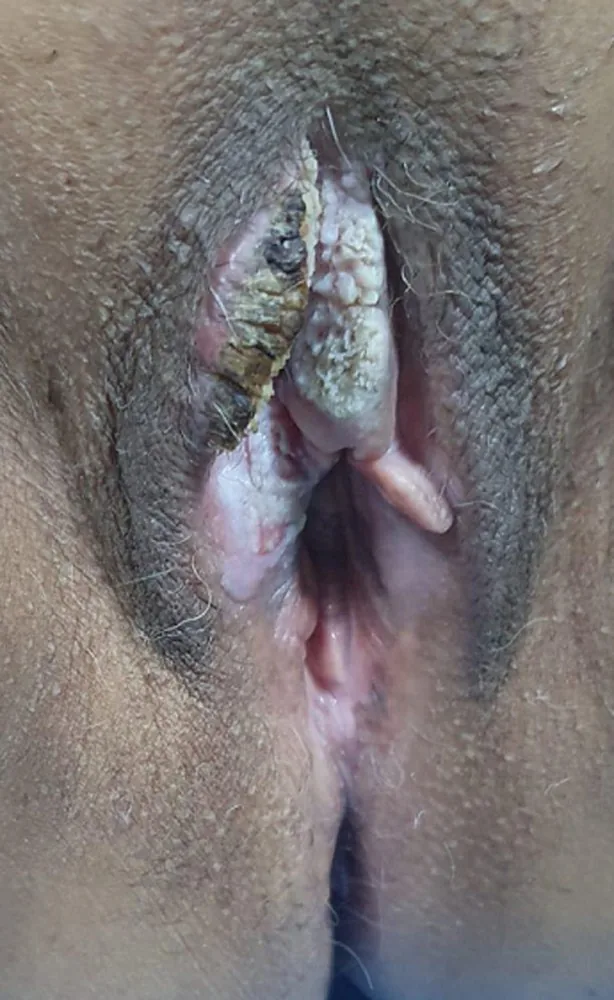
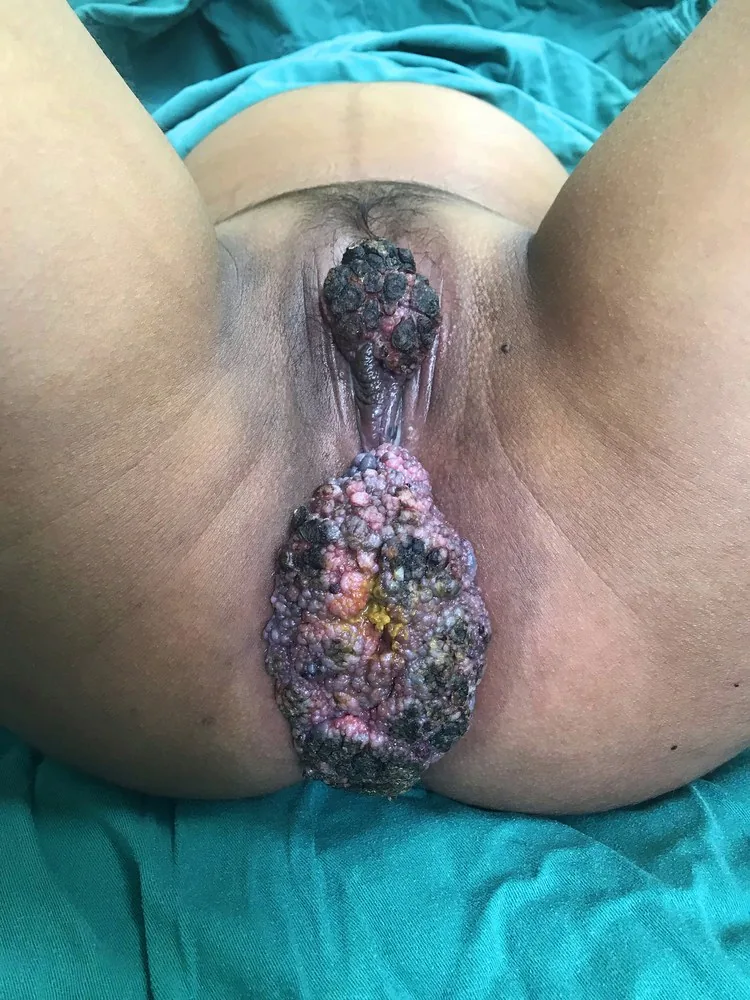
- Genital warts appear after an incubation period of 1 to 6 months; they may be painful, itchy or bleed.
- In women, warts occur most commonly on the vulva, vaginal wall, cervix and perineum; with reduced cell-mediated immunity, for example in pregnancy or HIV infection, they may persist and spread widely.
- Persistent high-risk infections lead via cellular changes and precursor lesions to cancer; cervical cancer usually takes 15–20 years to develop.
- Early cellular changes and precursor lesions mostly cause no symptoms; HPV 16 and 18 usually cause endocervical or anal intraepithelial lesions that are difficult to see clinically.
Diagnosis
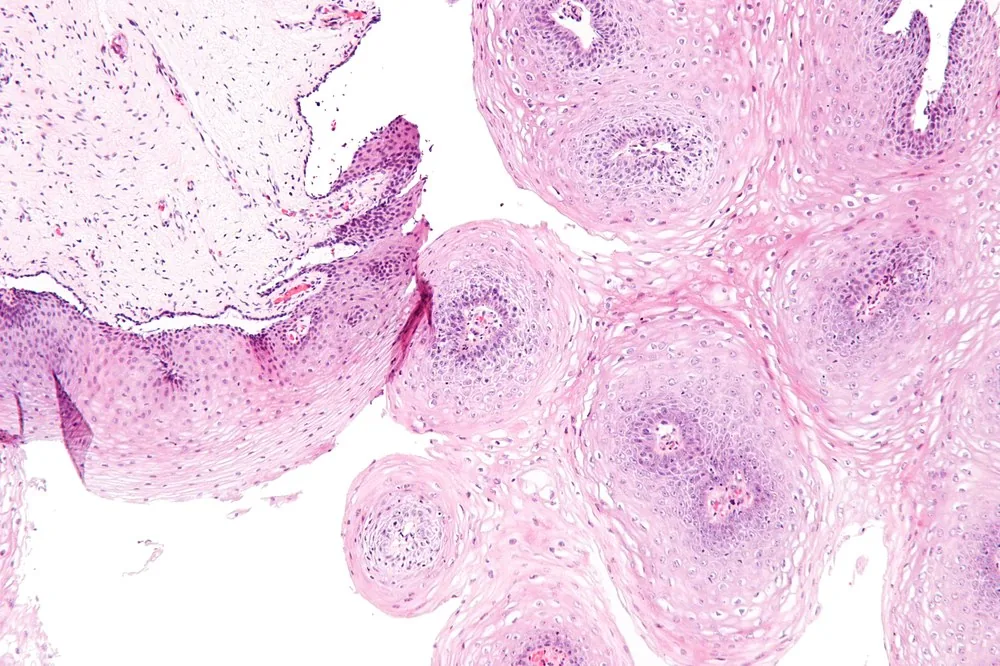
- Genital warts are usually diagnosed by visual inspection; atypical, bleeding, ulcerated or persistent warts may be biopsied to exclude carcinoma.
- At the cervix, nucleic acid amplification tests for oncogenic HPV types and cytology (Pap smear) are used; initial tests typically detect 13 common high-risk types.
- Cervical and anal intraepithelial lesions can be visualised only by colposcopy or anoscopy; on contact with 3 to 5 % acetic acid, they turn white and become easier to detect.
Keep learning in the app
Further reading (selection)
Cross-references
Note: Learning content from the GynFuchs app (flashcards, exam questions, image cases) for medical education – not a treatment recommendation and no substitute for diagnosis or treatment decisions in individual cases. Treatment and management are deliberately not covered on this page.