Congenital adrenal hyperplasia (CAH)
Exam relevance: in 1 of 197 board exam reports · rank 171
- Specialty
- Gynaecology · Endocrinology & cycle
- Images
- Diagram 1 · Mammography/MRI 1
- Exam relevance
- 1 of 197 reports · rank 171
- Last updated
- 10/2026 · Dr. Pascal Bafteh
Contents
Images (2)
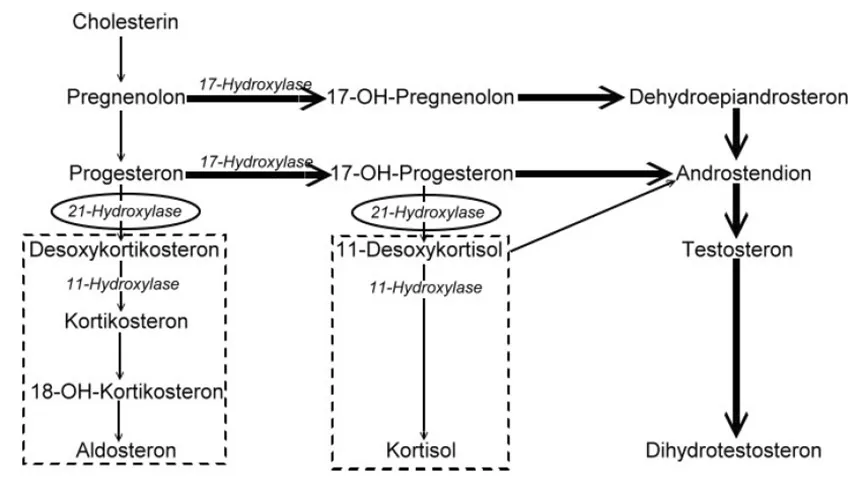 Diagram
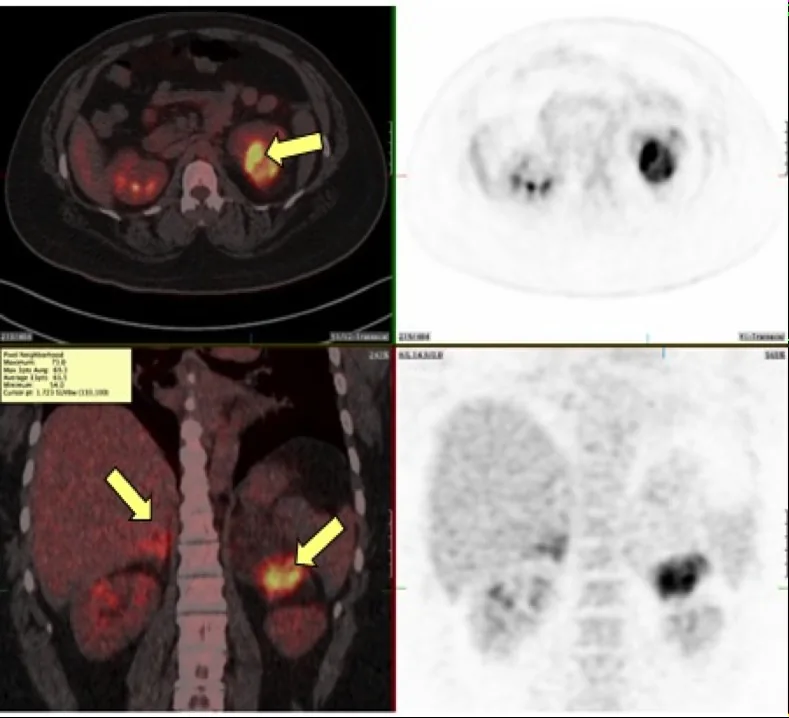 Mammography/MRI
Definition
- Congenital adrenal hyperplasia comprises a group of autosomal recessive enzyme defects of cortisol synthesis in the adrenal cortex; depending on the defect, there is additionally a deficiency or excess of mineralocorticoids and sex hormones, with androgen excess in the common 21-hydroxylase deficiency.
Classification
- About 90–95% of cases are due to 21-hydroxylase deficiency caused by mutations in the CYP21A2 gene; defects of, for example, 11β-hydroxylase or 3β-HSD are rarer.
- Clinically, classic CAH, either salt-wasting or simple virilising, is distinguished from the milder non-classic form, in which 20–80% of normal 21-hydroxylase activity is preserved.
Occurrence & epidemiology
Epidemiology
- Classic 21-hydroxylase-deficient CAH occurs in about 1 in 10,000 to 20,000 live births, about 75% of them salt-wasting; the non-classic form is more common, at about 1 in 1,000 in White populations and up to about 3% in certain groups such as Ashkenazi Jews.
Aetiopathogenesis
Aetiology and pathogenesis
- Cortisol deficiency increases ACTH secretion via loss of feedback, causing adrenal cortical hyperplasia, accumulation of precursors such as 17-hydroxyprogesterone and excess adrenal androgen production.
- Aldosterone deficiency in severe enzyme defects leads to salt wasting with hyponatraemia and hyperkalaemia.
Clinical features
- In girls with classic CAH, the external genitalia are virilised at birth with clitoral enlargement, labial fusion and a urogenital sinus, while the Müllerian ducts develop normally into the uterus and fallopian tubes.
- If unrecognised, the salt-wasting form can lead to a life-threatening adrenal crisis with hyponatraemia, hyperkalaemia, vomiting, hypoglycaemia, hypovolaemia and shock; aldosterone is low and renin is raised.
- Boys usually have normal genitalia, so the diagnosis may be delayed without screening; androgen excess presents in both sexes with early pubic hair and accelerated growth.
- Non-classic CAH is asymptomatic at birth and usually presents in childhood or adolescence, in girls with premature pubarche, advanced bone age, hirsutism, oligomenorrhoea and acne, resembling PCOS.
Diagnosis
- The key finding is raised 17-hydroxyprogesterone, measured in newborn screening; confirmation shows low cortisol and raised levels of DHEA, androstenedione and testosterone.
- In unclear cases and late presentations, an ACTH stimulation test with hormone measurement before and 60 minutes after ACTH helps; if results remain inconclusive, genotyping of CYP21A2 complements the work-up.
Keep learning in the app
Further reading (selection)
- MSD Manual Professional: Congenital Adrenal Hyperplasia Caused by 21-Hydroxylase Deficiency
- StatPearls: Congenital Adrenal Hyperplasia (NCBI Bookshelf)
- Genetics and Pathophysiology of Classic Congenital Adrenal Hyperplasia Due to 21-Hydroxylase Deficiency (J Clin Endocrinol Metab 2025, PubMed Central)
Cross-references
Note: Learning content from the GynFuchs app (flashcards, exam questions, image cases) for medical education – not a treatment recommendation and no substitute for diagnosis or treatment decisions in individual cases. Treatment and management are deliberately not covered on this page.