Androgen insensitivity syndrome
- Specialty
- Gynaecology · Endocrinology & cycle
- Images
- Diagram 1
- Last updated
- 10/2026 · Dr. Pascal Bafteh
Contents
Images (1)
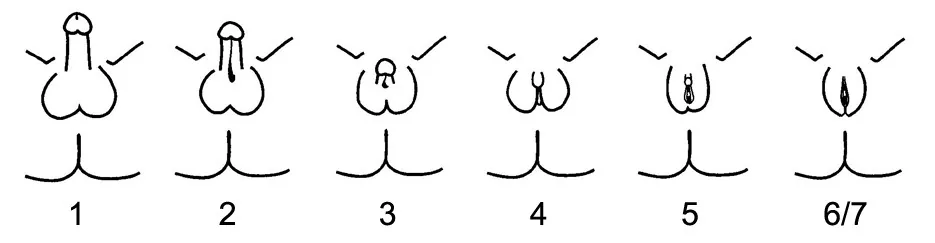 Diagram
Definition
- Androgen insensitivity syndrome is a difference of sex development in individuals with a 46,XY karyotype caused by impaired androgen receptor function; the complete form (CAIS) results in a typical female phenotype with functioning testes.
Classification
- Complete (CAIS), partial (PAIS) with varying degrees of undervirilisation and mild (MAIS) forms with male genitalia, infertility and/or gynaecomastia are distinguished.
Occurrence & epidemiology
Epidemiology
- The complete form affects about 2 to 5 in 100,000 female newborns; the partial form is thought to be at least as common.
Aetiopathogenesis
Aetiology and pathogenesis
- The cause is inactivating mutations in the androgen receptor gene on the X chromosome (Xq11-12) with X-linked recessive inheritance; about 30% of cases result from new mutations.
- The testes secrete anti-Müllerian hormone, causing regression of the uterus, cervix and upper vagina; breast development at puberty results from aromatisation of androgens to oestrogens in the absence of androgen action.
Clinical features
- Typical is primary amenorrhoea with normal breast development, absent or sparse pubic and axillary hair and a blind-ending vagina without a uterus.
- In childhood, the testes are often found in connection with a unilateral or bilateral inguinal hernia; there is also a risk of gonadal germ cell tumours, which is low before puberty.
Diagnosis
- Hormonally, LH is raised with normal to raised testosterone and usually normal FSH; after puberty, oestradiol is normal or slightly raised relative to the male reference range.
- The diagnosis integrates clinical findings, hormone tests, a 46,XY karyotype and sequencing of the AR gene.
Keep learning in the app
Further reading (selection)
Cross-references
Note: Learning content from the GynFuchs app (flashcards, exam questions, image cases) for medical education – not a treatment recommendation and no substitute for diagnosis or treatment decisions in individual cases. Treatment and management are deliberately not covered on this page.