Nursing recognition in Germany: Kenntnisprüfung, adaptation course and the licence for foreign-trained nurses
Auch auf Deutsch
Who needs recognition – and what exactly is it?
“Pflegefachfrau” and “Pflegefachmann” (registered nurse) are protected professional titles in Germany: to use them you need a state licence. § 1 PflBG It is granted when four requirements are met: equivalent training, personal reliability, health fitness and the German language skills needed for the job. § 2 PflBG That is why the official name of the recognition procedure is “Erteilung der Erlaubnis zum Führen der Berufsbezeichnung” (granting the licence to use the professional title). Anerkennungs-Finder
You can also apply for the titles “Gesundheits- und Kinderkrankenpflegerin/-pfleger” (paediatric nurse) and “Altenpflegerin/Altenpfleger” (geriatric nurse). § 43 PflAPrV § 58 PflBG According to the federal recognition portal, you can apply before you live in Germany. Anerkennungs-Finder
The process in five steps
- Find the competent authority and apply. A state authority is responsible – which one is listed in the table below.
Your application includes, among other things:
- a CV of your training and work in German,
- proof of identity,
- your training certificates translated by a publicly appointed or sworn translator (the authority may waive this or accept an English translation),
- any proof of work experience,
- if available: proof of German skills.
- Equivalence check (Gleichwertigkeitsprüfung). The authority compares your training with German nurse training. Differences can be offset by work experience or formally recognised lifelong learning. § 40 PflBG It must decide no later than four months after receiving your complete documents; in the fast-track procedure for skilled workers it should decide within two months. § 43 PflAPrV § 81a AufenthG
- Notice (Bescheid). If the authority finds substantial differences, you receive a notice you can appeal against (often called a “Defizitbescheid”, notice of deficits). It lists the subject areas or parts of training with substantial differences; for qualifications from non-EU countries the authority may depart from the detailed explanation and reasons. § 43 PflAPrV
- Compensation measure. You prove an equivalent level of knowledge with a knowledge test or an adaptation course – the choice is yours. This also applies if you cannot submit required documents for reasons beyond your control. § 40 PflBG
- Licence. Once equivalence, reliability, health fitness and German skills are proven, you receive the licence and have the same professional rights as someone trained in Germany. § 2 PflBG Anerkennungs-Finder
You can permanently waive the review of your documents. You then prove your knowledge directly with the knowledge test or the adaptation course; the authority must first explain the consequences and your choice. § 40 PflBG According to the recognition portal, the authority then does not prepare an equivalence report. Anerkennungs-Finder
Equivalence is meant to be checked before the other requirements, and on request you receive a separate notice on it. § 43 PflBG
Kenntnisprüfung for nurses: how it works
The knowledge test is a state examination before a state examination board – at a nursing school, a practical training facility or a facility the authority recognises as comparable. It has an oral and a practical part; you pass if you pass both. § 45 PflAPrV It covers the content of the German state final examination. § 40 PflBG
| Oral part | Practical part | |
|---|---|---|
| Task | One complex case with requirements from at least three competence areas – from a different care setting than the practical part and, for the Pflegefachfrau/Pflegefachmann licence, a different age group | Two to four care situations: carry out the tasks reserved for nurses, i.e. plan, organise, shape, deliver, manage and evaluate the nursing process and nursing assessment – with communication that fits the situation |
| Duration | 45 to 60 minutes | no more than 120 minutes per care situation |
| Format | working through a case orally | Examination with real patients; with the authority’s approval also as a simulation exam. The authority sets the care area (one of the mandatory placements) and the number of care situations Anlage 7 PflAPrV |
| Examiners | Two examiners, one of them a teacher at the nursing school | A teacher at the nursing school and a practice instructor (Praxisanleiter/-in) § 10 PflAPrV |
| Grading | “pass” or “fail” – pass if all examiners rate the performance at least “sufficient” (in the practical part: in every care situation) | |
| Resits | once | each failed care situation once |
All details in the table: § 45 PflAPrV
The knowledge test is to be offered at least twice a year. If the states use the regular dates of the final examination for it, they must make sure you can take it within six months of the notice. § 45 PflAPrV
Special format: the parcours exam
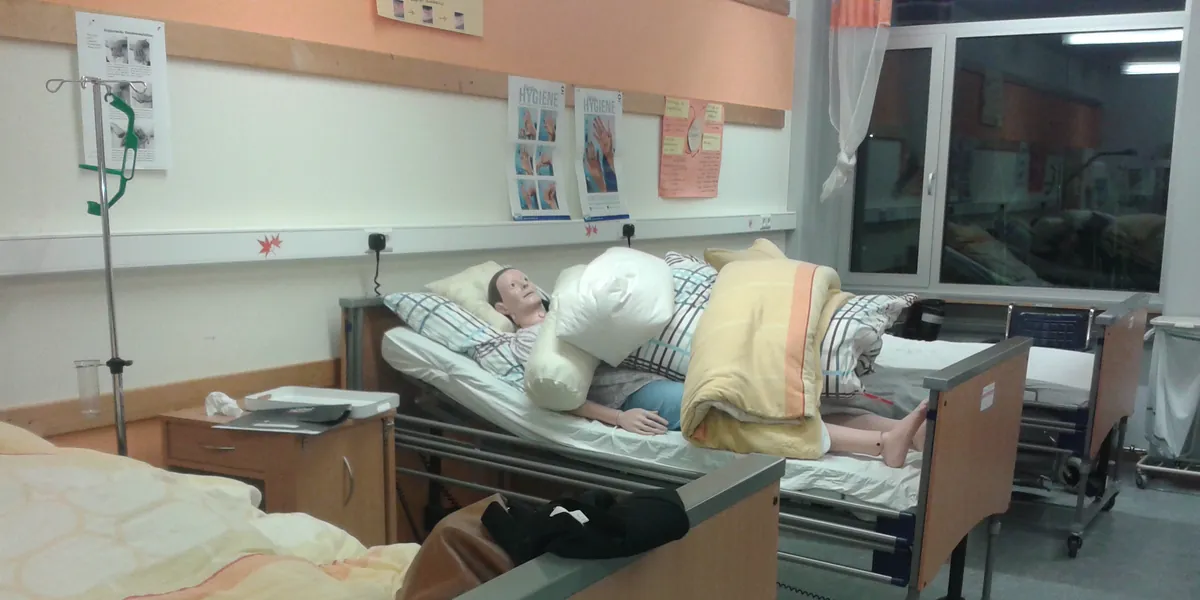
Instead, the knowledge test can be held as an applied parcours exam (anwendungsorientierte Parcoursprüfung): five stations with 30 minutes of examination time each, always as a simulation, with two examiners per station using a structured marking sheet and a fixed pass mark. You pass if you pass every station; it can be retaken once, and then in full. § 45a PflAPrV The competent authority tells you which format your exam takes.
Kenntnisprüfung for nurses: content
For the Pflegefachfrau/Pflegefachmann licence, the test covers the five competence areas of Annex 2 PflAPrV – the same ones the German state final examination is based on (English translation of the official German wording): § 45 PflAPrV Anlage 2 PflAPrV
- I. Plan, organise, shape, deliver, manage and evaluate nursing processes and nursing assessment in acute and long-term care situations responsibly
- II. Shape communication and counselling to suit the person and the situation
- III. Act responsibly within and across professions in different system contexts
- IV. Reflect on and justify your own actions on the basis of laws, regulations and ethical guidelines
- V. Reflect on and justify your own actions on the basis of scientific evidence and professional ethical values and attitudes
If you apply for the paediatric or geriatric nursing title, you are tested on the competence areas of Annex 3 or Annex 4. § 45 PflAPrV According to the glossary of the recognition portal, all content of the final examination may be tested, but not necessarily all of it. Glossar Anerkennungsportal
To revise the basics in German: nursing exam practice questions with answers (in German, on the nursing process, professional law, hygiene and prevention – not original exam questions), nursing admission interview (Pflegeanamnese) and care planning with the PESR scheme.
Adaptation course (Anpassungslehrgang)
- Length: up to three years. § 40 PflBG The authority sets the length and content so that the goal can be reached; it may take model reports of the Gutachtenstelle für Gesundheitsberufe (central expert office for health professions) into account. On a reasoned request from the training provider, the course can be shortened or extended – the authority decides within two weeks, otherwise the request counts as approved. § 44 PflAPrV
- Format: theoretical and practical lessons, practical training with theoretical instruction, or both – at nursing schools and training facilities or at facilities the authority recognises as comparable; a modular format based on a model curriculum is also possible. § 44 PflAPrV
- Completion: a final interview with an examiner and the teacher or practice instructor who supervised you. If it is not yet enough, the course is extended once, followed by another interview; if that does not succeed either, you may repeat the course once. § 44 PflAPrV
Knowledge test or adaptation course – the decision is yours. § 40 PflBG The competent authority can tell you which places and dates are available in your region.
German language: B2 – and in some states a specialist language exam
The law requires “the German language skills needed to practise the profession” but does not name a level. § 2 PflBG The 92nd Health Ministers’ Conference resolved on a nationwide standard for the language level. Hesse implemented it and has required B2 since 1 January 2023; before that, Hesse – according to the Regional Council of Darmstadt as the only state – accepted the “B1 Pflege” certificate. RP Darmstadt 2022
According to the current Recognition Finder entries, B2 applies in all 16 states. In nine states you must also show job-related German in a specialist language exam (Fachsprachenprüfung) – unless, for example, German is your mother tongue or you trained in German; the authority contacts you about it. In six states a language certificate or the nursing language exam (Fachsprachenprüfung Pflege) is enough. Anerkennungs-Finder For Hesse the sources contradict each other: the state office’s information sheet only asks for a B2 certificate from a fixed list. Merkblatt HLfGP 2024 Ask there what applies to you. Equivalence is meant to be checked before the language requirement. § 43 PflBG
Qualification from the EU, the EEA or Switzerland
For general care nurses there is automatic recognition if your training certificate is listed in Annex V point 5.2.2 of Directive 2005/36/EC, was issued after the reference date given there and meets the minimum requirements. § 41 PflBG The authority then decides no later than three months after receiving your complete documents. § 43 PflAPrV Otherwise you compensate for substantial differences with an adaptation course or an aptitude test (Eignungsprüfung), and you choose between them; the aptitude test is a practical exam combined with an examination interview. § 41 PflBG § 47 PflAPrV
Competent authorities in the 16 federal states
Queried in the federal Recognition Finder for the profession “Pflegefachperson” (nurse), a qualification from a non-EU country and each state capital. For another place of residence or work a different authority may be responsible, and the states may transfer tasks to another state or a joint body. § 40 PflBG The result for your own town in the Finder is what counts. Anerkennungs-Finder Authority names are given in German.
| State | Competent authority (seat) | German according to the Recognition Finder | Details |
|---|---|---|---|
| Baden-Württemberg | Regierungspräsidium Stuttgart, Referat 98 – Landesanerkennungsstelle für Gesundheitsberufe (Stuttgart) | B2; plus a specialist language exam (the authority contacts you) | Recognition Finder |
| Bavaria | Bayerisches Landesamt für Pflege (Amberg) | B2 (job-related); language certificate or nursing language exam (Fachsprachenprüfung Pflege) | Recognition Finder |
| Berlin | Landesamt für Gesundheit und Soziales (LAGeSo), Landesprüfungsamt für Gesundheitsberufe (Berlin) | B2 | Recognition Finder |
| Brandenburg | Landesamt für Arbeitsschutz, Verbraucherschutz und Gesundheit (LAVG), Dezernat G 1 (Potsdam) | B2; plus a specialist language exam (the authority contacts you) | Recognition Finder |
| Bremen | Die Senatorin für Gesundheit, Frauen und Verbraucherschutz (Bremen) | B2; certificate from an ALTE member or nursing language exam (at Paritätisches Bildungswerk) | Recognition Finder |
| Hamburg | Sozialbehörde – Amt für Gesundheit, Referat G114 Fachberufe im Gesundheitswesen (Hamburg) | B2; language certificate or nursing language exam (Fachsprachenprüfung Pflege) | Recognition Finder |
| Hesse | Hessisches Landesamt für Gesundheit und Pflege (HLfGP, Darmstadt) | Finder (14 Oct 2026): B2; plus a specialist language exam. HLfGP information sheet (24 Jul 2024): only a B2 certificate from a fixed list, no specialist language exam required. The two sources contradict each other – ask the HLfGP. Anerkennungs-Finder Merkblatt HLfGP 2024 | Recognition Finder |
| Mecklenburg-Western Pomerania | Landesamt für Gesundheit und Soziales (LAGuS), Landesprüfungsamt für Heilberufe (Rostock) | B2; plus a specialist language exam (the authority contacts you) | Recognition Finder |
| Lower Saxony | Niedersächsisches Landesamt für Soziales, Jugend und Familie, Außenstelle Lüneburg | B2; plus a specialist language exam (the authority contacts you) | Recognition Finder |
| North Rhine-Westphalia | Bezirksregierung Münster, ZAG-PuG (equivalence); then the licence from the responsible Bezirksregierung (district government) | B2 (job-related); language certificate or nursing language exam (at the NRW Chamber of Nursing, Pflegekammer NRW). You do not have to prove your German when you apply; you can do it later. Anerkennungs-Finder | Recognition Finder |
| Rhineland-Palatinate | Landesamt für Soziales, Jugend und Versorgung (LSJV), Referat 53 (Dienstort Landau) | B2; plus a specialist language exam (the authority contacts you) | Recognition Finder |
| Saarland | Landesamt für Soziales, Referat E1, nichtakademische Gesundheitsberufe (Saarbrücken) | B2; plus a specialist language exam (the authority contacts you) | Recognition Finder |
| Saxony | Kommunaler Sozialverband Sachsen (Leipzig) | B2; plus a specialist language exam (the authority contacts you) | Recognition Finder |
| Saxony-Anhalt | Landesamt für Soziales, Jugend und Gesundheit, Landesprüfungsamt für Gesundheitsberufe (Halle/Saale) | B2; language certificate or nursing language exam (Fachsprachenprüfung Pflege) | Recognition Finder |
| Schleswig-Holstein | Schleswig-Holsteinisches Institut für Berufliche Bildung (SHIBB), Gesundheitsberufe (Kiel) | B2; language certificate or nursing language exam (Fachsprachenprüfung Pflege) | Recognition Finder |
| Thuringia | Thüringer Landesverwaltungsamt, Referat Anerkennung ausländischer Berufsabschlüsse (Weimar) | B2; plus a specialist language exam (the authority contacts you) | Recognition Finder |
Frequently asked questions
What is tested in the nursing Kenntnisprüfung?
The competences needed for the profession – for the Pflegefachfrau/Pflegefachmann licence, the five competence areas of Annex 2 PflAPrV, from the nursing process to communication and counselling to acting on the basis of law and scientific evidence. In the oral part you work on one complex case (45 to 60 minutes); in the practical part on two to four care situations of no more than 120 minutes each (section 45 PflAPrV).
Knowledge test or adaptation course – who decides?
You do. The Nursing Professions Act gives you the right to choose between the knowledge test and an adaptation course of up to three years (section 40(3) PflBG). The competent authority sets the length and content of the adaptation course (section 44 PflAPrV).
Can I skip the equivalence check?
Yes. You can permanently waive the equivalence check and prove your knowledge directly with the knowledge test or an adaptation course. The authority must first explain the consequences to you (section 40(3a) PflBG).
How often can I retake the Kenntnisprüfung?
The oral part and each failed care situation of the practical part once each (section 45(7) PflAPrV). The parcours exam can be retaken once, and then in full (section 45a PflAPrV).
Does the reform of 1 November 2026 also apply to nurses?
No. The Act to speed up recognition of foreign qualifications in the health professions (Federal Law Gazette 2026 I No. 225) amends the laws for doctors, pharmacists, anaesthesia and surgical technical assistants, dentists and midwives – not the Nursing Professions Act. For nurses, the PflBG and PflAPrV continue to apply.
Sources
- Nursing Professions Act (PflBG), section 1: use of the professional title
- PflBG, section 2: requirements for the licence
- PflBG, section 40: equivalence and recognition of training (non-EU countries)
- PflBG, section 41: equivalence of training from the EU, EEA and Switzerland
- PflBG, section 43: separate notice on the qualification
- PflBG, section 58: paediatric nursing and geriatric nursing
- Nursing Training and Examination Regulation (PflAPrV), section 43: procedure, notices, deadlines
- PflAPrV, section 43a: required documents
- PflAPrV, section 44: content and delivery of the adaptation course
- PflAPrV, section 45: content and delivery of the knowledge test
- PflAPrV, section 45a: knowledge test as an applied station-based (parcours) exam
- PflAPrV, section 47: content and delivery of the aptitude test
- PflAPrV, section 10: examination board
- PflAPrV, Annex 2: competences for the state examination (Pflegefachfrau/Pflegefachmann)
- PflAPrV, Annex 7: practical training hours (mandatory placements)
- Residence Act (AufenthG), section 81a: fast-track procedure for skilled workers
- Act to speed up recognition of foreign qualifications in the health professions of 22 July 2026, Federal Law Gazette 2026 I No. 225
- Recognition in Germany (information portal published by the Federal Institute for Vocational Education and Training, BIBB): Recognition Finder, profession Pflegefachperson (nurse), entries dated 14 Oct 2026 or 27 Oct 2026, retrieved 13 Nov 2026
- Hessian State Office for Health and Care (HLfGP), Department IV3 Nursing Professions: proof of sufficient language skills for the recognition of nursing qualifications obtained abroad, information sheet, as of 24 July 2024 (in German)
- Recognition in Germany (BIBB): glossary, entry “Knowledge test”, retrieved 13 Nov 2026
- Regional Council of Darmstadt: implementation of the 92nd Health Ministers’ Conference resolution on required German language skills in nursing, letter of 25 Jan 2022 (published by IQ Netzwerk Hessen)
Note: this guide summarises German law and official information for orientation. It is not legal advice for individual cases and contains no fee information; the competent authority of your federal state and the current versions of the PflBG and PflAPrV (gesetze-im-internet.de, last amended by the Act of 22 Dec 2025) are decisive. Translations of German legal terms are our own. Sources checked on 13 November 2026.