IHS4 calculator (International Hidradenitis Suppurativa Severity Score System)
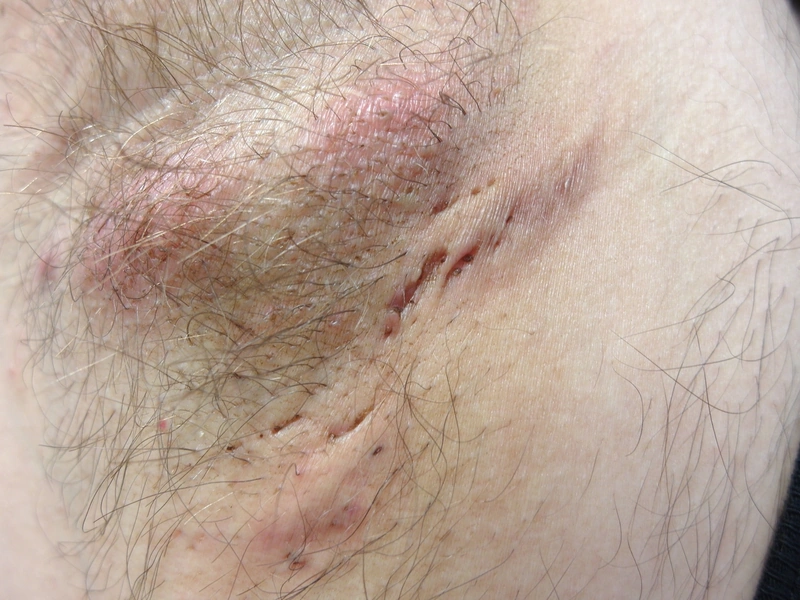
The IHS4 is a dynamic severity measure for hidradenitis suppurativa. Count inflammatory nodules, abscesses and draining tunnels (fistulas) across all regions.
⚠︎ Learning tool for medical education – not for use in patients or for treatment decisions.
Classification (original publication)
| Score | Classification (original publication) |
|---|---|
| ≤ 3 | Mild HS |
| 4–10 | Moderate HS |
| ≥ 11 | Severe HS |
Calculation and interpretation
IHS4 = number of nodules × 1 + number of abscesses × 2 + number of draining tunnels × 4. A score up to 3 corresponds to mild, 4–10 to moderate and 11 or more to severe hidradenitis suppurativa (Zouboulis 2017).
IHS4 and Hurley
Hurley staging is a static clinical classification based on scarring and tunnel formation and cannot be derived from IHS4 counts. The two complement each other: Hurley describes scarring, the IHS4 current inflammatory activity and is suitable for monitoring.
FAQ
Can the Hurley stage be derived from the IHS4?▾
No. Hurley is assessed clinically by scarring and tunnels; the IHS4 counts active lesions.
References
- Zouboulis CC et al. Development and validation of the International Hidradenitis Suppurativa Severity Score System (IHS4). Br J Dermatol 2017;177:1401–9. · PubMed
More Dermatology calculators
Keep learning: test yourself
One question from the KLINIKFUCHS app on this score – tap an answer.
Question 1 of 1
What elements are used in the iHS4-Score for monitoring acne inversa?
Answer
Correct: nodules + abscesses + sinus tracts. The iHS4-Score for acne inversa is based on the presence of nodules, abscesses, and sinus tracts to assess disease severity.
More questions like these – with explanations and spaced repetition – in the app.
All calculators in the app
In DermaFuchs you practise PASI, EASI, mRSS, IHS4, UAS7 and more – and learn dermatology with flashcards, spot diagnoses and a dermoscopy course.
Open in browser Download on the App StoreIntended purpose: learning tool for medical education only. Not intended for use in patients or for diagnostic or treatment decisions; not a medical device. Calculations follow the cited original publications; no guarantee of completeness or correctness. Last updated: 10/2026 · Dr. Pascal Bafteh